Thursday, December 30, 2021

Improving a freight car

 A couple of months ago, I had a challenge suggested to me by email. The suggestion was that I go through the process I would use for a freight car kit, to make it more accurate, to improve details, or whatever might be needed to improve the kit. An interesting suggestion!

What I’ve chosen for this assignment is an InterMountain kit for a 12-panel, 40-foot box car. It represents a Texas & New Orleans box car of SP Class B-50-26.

What are these 12-panel cars? The 12-panel design was briefly a “fad” after World War II, as a way to save weight by using thinner steel for side sheets. But the thinner sheets were less stiff, so the compensation was an extra side post at the seam of that extra side sheet. Before long, it was decided that the weight saving wasn’t worth the changes. But for a couple of years, a number of railroads bought such box cars.

The Southern Pacific was one. During 1946 and 1947, they purchased 2600 12-panel box cars to the design of their Class B-50-25, followed by 3000 cars of Class B-50-26. Of the total of 5600 cars, 2350 were for T&NO, the rest for Pacific Lines. These were all of 10-foot inside height, which after World War II was an obsolescent dimension. A few other railroads also purchased 10-foot IH cars after the war, including Great Northern and Baltimore & Ohio.

So how would I go about deciding what aspects of the kit to replace or upgrade? Obviously the first step is prototype photos, which can readily show the prototype’s doors, ladders, sill steps, etc., but rarely show the roof and may not show trucks or car ends well. So second, a source of information on the things not shown in photos is essential.

We can readily determine that the InterMountain kit accurately represents the SP car body for Class B-50-26, with an “Improved Dreadnaught” end, 3 ribs over 4 ribs, abbreviated 3/4) in configuration, and a straight-panel roof. This basic body is shown below in an American Car & Foundry builder photo, with the 3/4 end configuration very clear. This is the end modeled by InterMountain.

The body of my kit is shown below, lettered for T&NO, and correctly including the “builder emblem”for AC&F. It’s numbered T&NO 56729. It would have been part of a 750-car group, T&NO 56450–57199.

That this is a correct paint scheme can be seen in the builder photo below, although the car shown below is from the following class, B-50-27, with different ends and roof from the preceding Class B-50-26 cars. It’s a Pullman-Standard builder photo, just chosen to show the lettering. 

The 5600 SP and T&NO 12-panel cars had a variety of specialties installed, and it’s necessary to consult historical sources to know which cars had which appliances. My book on SP box cars, Volume 4 in the series, Southern Pacific Freight Cars (Signature Press, revised edition 2014), is such a source. The first thing I did was consult the book’s Table 12-3, giving specialties by number group for Class B-50-26.

For the model’s car number, T&NO 56729, the Table shows that it should have Ajax handbrakes, a Morton steel running board, Camel-Youngstown 6-foot doors, and ASF A-3 trucks. 

The two prototype photos above show the type of welded door needed: typed by the ribs in each of the three sections, it’s a 4/5/4 rib pattern, and has raised seams between sections. This is not what the kit’s door look like, as you can see below in a photo of the kit’s door sprue; they don’t have the raised section between panels, and are riveted.

I went to my stash of freight car parts to find the needed 4/5/4 welded doors with raised seams. I happen to have some cast resin copies of Branchline postwar doors, and these doors have the right configuration. They are from patterns made by John Spencer (with Branchline’s permission). However, they aren’t exactly right, because they are a little too tall for a 10-ft. IH car. That will be corrected in kit assembly. Here you see them with flash still present.

The kit also includes a running board apparently intended to resemble a U.S. Gypsum running board, though not terribly well done; I decided to use a Kadee Morton running board to match my prototype. The kit has an Ajax brake wheel, but I will use the better molding from Kadee. Finally, the kit’s sill steps are not the same shape as the SP prototype, and A-Line steps can be used as replacements.

With these major issues with specialties identified, I am turning to building the kit. I will return to that part of the story in a future post.

Tony Thompson

Monday, December 27, 2021

More family ops

 Once again, with my granddaughter in town for the holidays, we set up an operating session. The layout had only been cursorily run in recent months, so the first need was a thorough track cleaning. And I suppose it was natural that something would fail. In this case, it was a point rail, breaking the solder joint between it and the throwbar of a switch (the East Main switch at Ballard). You can see the lower point rail below, with a dot of bare solder next to it, where it separated. This was quickly re-gauged and re-soldered.

I should mention that this switch has had its rails cleaned a couple of times in recent months, with no problems, until of course an op session was imminent. I have a friend who always refers to such events as “pure IO,” meaning the “Perversity of Inanimate Objects.”

I then set up the various industry set-outs and pickups, as I would for any session. This time, I wanted my granddaughter to do more than just run the locomotive, good as she is at that task, so I prepared a switch list instead of handing her a handful of waybills. My plan was to be more of a spectator and do less of the conductor role. 

Our layout rotation called for us to switch Ballard for this session. The eight-car local train pulled into town on the normal eastward main, then the locomotive ran around the consist. The locomotive, just visible here behind the consist at center, is running around to start work from the back of the train.

Shown below is the engineer-conductor preparing to start work at Ballard, holding the clipboard with the fresh switchlist. She is planning out the first moves for the session.

As switching progressed, all the cars to be pulled from the front-side tracks, north of the main track, were set over onto the westward main track. The locomotive here is pulling those cars down to the left to clear Bromela Road, which is just beyond the end of the train at far right.

With that work completed, the industries to the south of the main were switched, including Jupiter Pump & Compressor. Here you see the locomotive, SD&AE Consolidation no. 103, backing those pickups into the house track to acquire the caboose, preparatory to leaving town.

Finally, with all nine cars picked up, the train returned up the branch to the mainline junction at Shumala. Here is the train, arriving there.

This session went smoothly. The young engineer is pretty familiar now with the layout and how switching is done. She did a full set of set-outs and pickups, very much as any visiting operator would have done. Nice to be able to exercise the layout this way!

Tony Thompson

Friday, December 24, 2021

Richard Steinheimer, Part 2

 Almost since I was aware of railroad photography as something beyond snapshots of interesting trains, I recognized the quality and, often, the drama of a Steinheimer image. As I mentioned in the previous post, this began for me in the 1950s in Trains magazine (you can see that post at: https://modelingthesp.blogspot.com/2021/12/richard-steinheimer.html ). 

I should mention that my grasp of Steinheimer’s work was immensely increased by visiting the DeGolyer Library at Southern Methodist University in Dallas, where the great bulk of Dick’s pre-1970 negatives reside. When I first visited there in 1988, the photo curator at the time, Kay Bost, allowed me quite free access to the Steinheimer negatives, but warned me that prints would be expensive. The Library appreciated that, in a sense, these were art photos, and accordingly used a high-end lab to make good quality prints. These would be expensive. I replied that to me, that was actually good news. 

She then added that if I wanted to obtain permission to publish any, I could wait until I chose such photos, and individually request permission then (and pay a fee for each), or I could pay a fee up front for permission to use any and all of the prints I was ordering. Luckily, I chose the latter option. Most of what you see in this post are from those prints.

In the present post, I want to offer a few amateur’s comments about the Steinheimer images that have struck me. One thing evident from the very beginning of seeing these was his ease with night shots. Doing these well is of course not trivial, and years before O. Winston Link’s wonderful night shots on the Norfolk & Western gained visibility, Steinheimer was doing them frequently. Here’s one I like, the operator at Saugus, California handing up orders to eastward No. 806. Note that we see the entire operation: the operator hooping up, and the fireman reaching out for the hoop.

This photo also includes another real skill of Steinheimer’s, portraying employees doing their job without any apparent awareness of the photographer. Dick told me one time that his approach to such photos was to chat with the employee for a few minutes and set any misgivings at ease. Then he would move a little ways away and wait for the right moment.

Below is an example of this. It comes from a set of about 20 photos Dick took in the Los Angeles PFE shops in December 1950, showing car rebuilding (negatives at the DeGolyer). His aim, he told me, had been that PFE would want to buy the images for publicity use. To his dismay, PFE made clear that the last thing they wanted to publicize was rebuilding of old equipment. I used many of these images in the Car Shops chapter of the PFE book. This one shows workmen completing a rebuilt car interior.

Dick is of course known for his many dramatic and even artistic images. But he took lots of photos that could be called “documentation,” too. One example, which was included in Backwoods Railroads, is this useful view of the Santa Maria Valley Railroad with its typical pair of GE 70-tonners, passing the La Brea Ice Co. deck in Santa Maria. Like many of Stein’s images at the DeGolyer, this was in a paper sleeve with his trip notes typed on the outside, most interesting and informative.

 (By the way, it’s true his nickname was “Stein,” but primarily in the third person. Most who knew him, including me, always addressed him as “Dick.”)

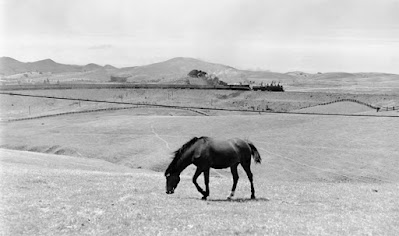
One of the most famous Steinheimer photos is his image of the horse in the middle of Horseshoe Curve, above San Luis Obispo. As I know from looking at his negatives at the DeGolyer Library from this day in 1953, he took photo after photo of passing trains, always with the horse turning his rear toward the camera, or with his head down. Here’s just one of the images.

But Dick just wasn’t happy with what he was getting, as he once told me. Finally, the descending Daylight blew its air horn for the Gold Tree crossing, and the horse raised his head. That was the shot Dick wanted, and that’s the famous image. But this episode shows that even the great photographers have to have both vision and patience, and may expose lots of shots you would normally never see.

These five photos are a necessarily brief representation even of my own favorites among Dick’s work, never mind the innumerable favorites of others. But I wanted to keep this at a reasonable length. I will conclude my comments in a forthcoming post.

Tony Thompson

Tuesday, December 21, 2021

The shortest day comes around again

 The shortest day, December 21, falls this year on one of my usual posting days for this blog. December 21 has long been a day of note for me, beginning with the fact that my dad invariably spoke of it. So once again, I want to repeat a post from 2012 on this topic, including a wonderful poem by Susan Cooper about this day and why it’s an occasion. I repeat it below.

The shortest day

One of my vivid memories from childhood is my father relishing this day, which seemed odd to me then, what with the days shortening and the nights closing in, and of course colder and rainier weather. But he always said, “Now the days will be getting longer,” and of course, so they will.


What hadn’t occurred to me in those days was that humans for many, many centuries have had the same feelings about this day that my dad did, and in more primitive times, for better reasons.


Ever since my wife and I discovered the performances known as Christmas Revels, we have attended here in the Bay Area, more years than not. Revels was created by John Langstaff in 1957, and the tradition gradually grew and extended over the years. Today Christmas Revels is performed in several cities around the country (for the location of those cities, you can visit their map at this link: http://www.revels.org/about-us/revels-nationwide , and from there go to their home page to learn more about their history and what Revels is.)


A favorite part of the performance of every Christmas Revels is the reading, toward the end, of a poem by Susan Cooper, written for Revels in 1977 and for me a delight. I reproduce it below, with permission from Cooper, to whom I wrote an email and requested the use. (The poem is all over the Internet, in both written and spoken form, though often mis-punctuated and sometimes with words changed — imagine the nerve!) 

She sent me a copy of it as she wrote it, so that it could be presented correctly. (If you’d like to know more about her, please visit her web site: http://www.thelostland.com/ .) She also mentioned that she was happy to give permission for use in this blog, as she is descended from three generations of English railwaymen!

THE SHORTEST DAY

By Susan Cooper

So the shortest day came, and the year died,
And everywhere down the centuries of the snow-white world
Came people singing, dancing,
To drive the dark away.
They lighted candles in the winter trees;
They hung their homes with evergreen,
They burned beseeching fires all night long
To keep the year alive.
And when the new year's sunshine blazed awake
They shouted, revelling.
Through all the frosty ages you can hear them
Echoing, behind us -- listen!
All the long echoes sing the same delight
This shortest day
As promise wakens in the sleeping land.
They carol, feast, give thanks,
And dearly love their friends, and hope for peace.
And so do we, here, now,
This year, and every year.
Welcome Yule!

     A far more eloquent presentation of our traditions than I could ever have written. I hope you enjoy it as much as I do.
Tony Thompson

Saturday, December 18, 2021

Richard Steinheimer

 I was tempted to call this “An Appreciation,” but Steinheimer’s reputation needs no appreciation from me. Let’s just call it a reminiscence. I have always been surprised to hear younger modelers not completely sure who Steinheimer was. I want to begin with his many publications.

Dick was eleven years older than me, and as it happened, attended the same high school as me, Herbert Hoover High School in Glendale, California. He began railroad photography in 1945, when he was 16, and soon graduated from a Baby Brownie to an Argus and, in 1947, to a Speed Graphic. 

Even his earliest photos show a distinctive “eye” for composition. I often realized in the 1950s, when I would open a new copy of Trains magazine, that I could recognize a Steinheimer photo at a glance. David P.  Morgan, editor of Trains, was an early enthusiast of Dick’s photography and published it often.

But I think that there had not been major attention to Steinheimer beyond readers of Trains until 1963. Two books were published that year featuring his photography, the first of many. One was Backwoods Railroads of the West (Kalmbach), a 9-1/4 x 13-inch horizontal format book, entirely of his images. 


 The book was not commercially successful, and both Kalmbach and Dick were disappointed. Some said it was the word “West” in the title, with so many railroad enthusiasts living in the eastern two-thirds of the country. Others thought it was the word “Backwoods,” since that suggested small, obscure railroads, though in fact many mainline railroad images are in the book. But it remains a marvelous collection of Steinheimer photography, readily purchased on line.

The second was The Central Pacific and Southern Pacific Railroads, by Lucius Beebe (Howell-North ), an 8-1/2 x 11-inch, 632-page book, which as the front cover mentioned, featured 121 of Steinheimer’s photos. This seems to have suddenly created recognition from many who had not fully appreciated the occasional images in Trains.

A long-gestating project of Dick’s was a collection of his marvelous photographs of the Milwaukee Road electrified lines, entitled The Electric Way Across the Mountains (Carbarn Press), 1980. Dick often spoke of this book as his finest work, and I had the pleasure of working with Dick and his wife, Shirley Burman, to produce a second edition of the book, published by Signature Press(2005).

In 1982 and 1983, Interurbans Press in Pasadena produced a pair of excellent photo albums, entitled Growing up With Trains, the first a Southern California album by Dick and his longtime friend and fellow photographer, Don Sims, the second by Dick and Ted Benson. Volume 2’s cover is a photo by Steinheimer of Dick Dorn in the snow. Both are 8-1/2 x 11-inch softcover books.

 There have been two beautifully produced overviews of Dick’s work, both with a strong biographical content. The first was Done Honest & True (Pentrex, 1998), with an appreciative text by Ted Benson. It features many of Dick’s finest photos. It’s a 9 x 12-inch vertical format soft-cover book.


The other is the monumental and truly serious photographic compendium, A Passion for Trains (W.W. Norton, 2004), with an informative text by Jeff Brouws. (You just know it’s an art book when the pages aren’t numbered.) Roughly 12 x 12 inches in size, it’s a magnificent reproduction of Dick’s best work, and I have said to a number of people that if you just want one Steinheimer album, this is the one to have.

This isn’t every Steinheimer book, but it is a good sample. I also want to offer some personal impressions of the photographs themselves, but will reserve that for a future post.

Tony Thompson

Wednesday, December 15, 2021

Distributing ice reefers

 The title of this post may seem ambiguous, but bear with me. I am referring to the way(s) that empty ice reefers were, or may have been, moved to the shippers that ordered them. Here I assume the reader knows the background of Empty Car Bills, Waybills, and so on. If you don’t know, you can use either term as a search term in the search box at right, to find my earlier posts on those topics.

The crew of a local freight train, pausing to work in a particular town and with only a single packing house in that town, would certainly know where the empty reefer in their train was headed. So if the train was like the one below, arriving in my layout town of Santa Rosalia and pulling down to the depot to confer with the agent, the crew didn’t need to be told about the reefer.  The agent, who had placed the order for the car, could tell them where it went, but they know very well that it’s headed for Coastal Citrus, at left of this view.

The locomotive here is SP 2344, a Ten-Wheeler, and today the local crew has been saddled with one of SP’s cordially disliked boxcar cabooses, SP 18037, a “temporary” conversion and a lot less comfortable to ride than a conventional caboose. It’s a Westerfield model.

And of course both agent and crew assume that the car they are delivering was correctly chosen by the Car Distributor to fulfill the order. If pre-iced, that was probably done at the ice deck in the local train’s departure town. So they can spot the empty with no further thought.

But what if the situation is more complicated? There may, for example, be two packing houses, both of which have requested empties, and perhaps, as in my layout town of Ballard, one of them (Guadalupe Fruit) has requested a pre-iced car and the other (Western Packing) wants an un-iced car. Now there may be two or several empty reefers in the train. But unless the crew sees water coming from the drain chutes on one of the cars, they can’t tell from the outside which car is which. No problem, the agent can tell the crew which is which.

Here the Santa Rosalia local is just arriving in Ballard, with, as usual, the locomotive running in reverse on the outward leg of the job (it’s SD&AE Consolidation no. 103). Where the two reefers are to be spotted is not yet known to the crew, as there are four packing houses here. They will get the answer from the agent.

But it can be even more involved. I am well familiar with the idea that a group of packing houses, all packing the same crop, will receive the exact same car types. This is implemented at the La Mesa Club’s famous Tehachapi layout in San Diego, when one switches Arvin. The Arvin switch job goes out with a string of 30 reefers, all nominally identical, and spots them at about 8 packing houses, all of them loading potatoes. 

I’ve described this process, devised I believe by Jason Hill, before: http://modelingthesp.blogspot.com/2012/11/operating-on-tehachapi-part-2.html . Below is a photo from that post, showing two of the large potato houses (only in the form of paper signs when this photo was taken), and their triple-track sidings. Just as at prototype Arvin, the houses load potatoes in three-abreast cars.

Naturally, it doesn’t matter which house gets which car; but it will matter when the cars are loaded, so the switch crew has to make up a switch list of which cars came from which houses, and then the various destinations of each house’s cars can be added to outbound directions. In the foreground of the photo above, you see the switch list being compiled by the conductor of this job, which identifies who loaded which car.

But what if the cars are not interchangeable? In my visit last October to the Twin Cities, I had the pleasure of operating on the layouts of Mike Jordan and Bill Jolitz, both of whom have devised interesting challenges for crews spotting empty reefers. (My brief description of both is at this link: https://modelingthesp.blogspot.com/2021/11/out-of-town-operating-part-3.html .) Mike in particular has a scheme where some shippers have ordered fan-equipped cars, and the switch crew has to select from the available empties to supply the correct cars. 

This could well be realistic. Car fans were a great help, both in speeding the initial cooling of a load, and also in making and keeping internal load temperatures uniform throughout the car. In particular, any shipper needing pre-iced cars could well also order fan cars; so might shippers of denser produce like melons or citrus, for which temperature uniformity was more of a challenge.

So if a crew has several empty reefers to deliver in a particular town, and the agent message merely directs them to place the car(s) with fans at one shipper, how do they identify those cars? During one period, PFE painted the fan shafts, or a metal plate representing a fan, black, and these are easy to see above the left-hand trucks, as in this photo of a Class R-40-26 model:

But farther into the 1950s, as the all-orange sides came to include fan shafts or plates, you have look more closely. For a time, an outline symbol was used, as shown below on an InterMountain model of Class R-30-18:

I will experiment with crew messages and other means to direct crews to spot the fan cars at the right shipper. If any of it seems interesting I will report further in a future post.

Tony Thompson

Sunday, December 12, 2021

More about flat car decks

 One of the model freight cars that I most often see on visited layouts that cry out to be “improved” are flat cars. Not because the car body itself is in any way wrong (though it may be), but because of the deck. This involves a number of issues.

There is a myth among many modelers that the lumber of flat car decks was creosoted, and doubtless some railroads at some time periods must have done so. But non-creosote types of pressure-treatment for wood that would see outdoor service were available before World War I, and Railway Age articles in that period of rapid change in freight car technology do refer to these treatments. My own impression from photographs is that even in the 1920s, and certainly by the steam-diesel transition era, creosoted decks were rare to non-existent.

Of course a bigger issue in the color of decks is simple aging due to sunlight and changes in the wood with age (even wood inside the walls of structures, exposed to no sunlight, darkens considerably with age). Of course any flat car fleet would contain a few cars, either freshly delivered or freshly re-decked, but most would have varying degrees of darkening from age.

I have discussed weathering methods to achieve these changes in deck color in my “Reference pages,” with links at the top right of this blog post, and in a prior post, at: http://modelingthesp.blogspot.com/2011/05/weathering-flat-car-decks.html . Below are examples.

In this photo, the uppermost car has a plastic deck, and the lower two have wood decks. All have been scraped, gouged, scored and roughened to give some realistic texture. Then all have been worked with acrylic tube colors, not washes but painted, mixing Neutral Gray, Burnt Umber, and Black. These decks look considerably more realistic than fresh wood or, worse, freight car color. Few railroads bothered to paint flat car decks.

Yet another issue to be recognized is wear and tear. Blocking and other dunnage for loads was routinely spiked to the wood deck. Over time, this steadily tore up the deck surface. For any flat car of moderately advanced age, it is difficult to reproduce these levels of damage in models. In addition, many consignees receiving a shipment on a flat car simply left the old dunnage, spiked down or not, for someone else to remove. The same goes for miscellaneous steel strapping, cables and ropes, and sometimes even tarpaulins.

There are lots of examples out there in prototype photography Let me show just one, a Richard Steinheimer photo (DeGolyer Library). It was taken from Glendale Tower, and the Southern Pacific double-track main is here crossing the Pacific Electric’s double track running in the center of Brand Boulevard, the street you see (notice the overhead wires). Coming toward the camera is SP 6153, heading up Train 804, a train from Bakersfield, and a westward freight out of Taylor Yard is passing it on the right. Our subject now, of course is the two flat cars.

Doubtless, Steinheimer was not interested in the flat cars, except that they provide a gap in the train though which he could photograph the oncoming diesel locomotives. But even a glance shows the rough condition of the foreground car’s deck, which is in sunlight (Train 804 shadows the other one). Let’s look at it more closely.

There are numerous wood blocks or strips in places around the deck, a jumble of what looks like steel strapping at the far end, and some other material, strapping or cable, nearer the camera. And the deck surface is quite extensively distressed. 

Would all this junk remain on the flat car when it is spotted at the next shipper’s siding? Likely not. Most yards had a clean-out track, and cars about to be delivered would be cycled through there if needed. But the car we see above must be destined to somewhere well beyond Taylor Yard, since they haven't cleaned it.

It’s my belief that a flat car fleet ought to contain at least a few cars showing a bunch of dunnage. Here is one example, modeled by Richard Hendrickson, and it certainly is a clear example of what I’m talking about (it’s a Proto2000 model). Of course, if the same flat is to accommodate (removable) loads also, the dunnage has to be judiciously placed so as not to interfere with those loads. This model also shows considerable distressing of the deck (you can click to enlarge if you wish.)

The comment about loads reminds me to mention that in general, I am an advocate of removable loads. Occasionally a load requires complex tie-downs and is better installed as a permanent load, but I would usually rather cut some corners on the completeness or accuracy of tie-downs in favor of a readily removable load.

And lastly,  this commentary on flat car decks reminds me that I, too, have a few cars with far-too-clean decks, and will need to pull a few cars back onto the bench for some work.

Tony Thompson