There is one aspect of handling empty cars on the SP which is worthy of further comment. I discussed empty car handling and Empty Car Bill paperwork in a prior post on waybills, available at: http://modelingthesp.blogspot.com/2011/06/waybills-8.html.
Most towns with any significant amount of industry in the steam era would have an agent, housed in one or another type of depot or freight house, to handle paperwork. But very small towns, or places where the depot had been closed, were known as “non-agency” stations. In such places, the kind of agent’s work I described in the previous post (at: http://modelingthesp.blogspot.com/2011/10/operations-role-of-agent.html ) could not take place.
On the SP, there was a second kind of Empty Car Bill, called Form 1304, which had an added section to designate the shipper to whom the car destined. This was to be used at non-agency stations, and a memo was issued to conductors, agents and clerks to specifically identify this use of Form 1304. That way, the switching crew would know where to spot a car without having to get the information from an agent. I have used this form for Otis McGee’s layout waybill system. Here is an example of a Form 1304 Empty Car Bill:
This is like the standard Empty Car Bills except for the lowermost line in the “For Loading” section, offering the specification of shipper and car spot (as SP did in its Form 1304). Note that the form number itself is included in the upper righthand corner of the bill (to see it, you may have to click on the image to enlarge it).
For simplicity, this form is being used exclusively on Otis’s layout, even though in principle it could be restricted to use at non-agency stations. It is not a major point, but use of this form is one more prototype detail which is intended to add to the realism of operation on this layout.
Tony Thompson
Thursday, November 3, 2011
Tuesday, November 1, 2011
Operations: demand-based car flow
In what may require several posts, I want to explain my method of setting up car flow on my layout. What I mean by “car flow” is the pattern, whether or not a regular pattern, in which cars move to and from industries. As is the case for the prototype, the idea behind my approach is that the flow is in response to shippers, not to anything else. Shippers need empty cars to load, or they receive loaded cars which they unload. Either way, it is the ebb and flow of their particular business that creates these car movements. It is not yardmaster decisions or conductor decisions or even layout owner decisions (at least not directly). This is the starting point for the system I have devised.
This post continues some of the discussion I initiated in talking about the role of the local agent in my system, and though the agent has some leeway, car flow is not fundamentally determined by agent decisions either (see http://modelingthesp.blogspot.com/2011/10/operations-role-of-agent.html).
Obviously the combined car flow for the entire layout is merely the sum of the car flows for all the industries modeled (using “industry” broadly to include any place where cars may need to be spotted, including team tracks and depot house tracks). That means that the first step in constructing a car flow system is to examine each industry in turn. What kind of inbound loads will it receive, what kind of empties will it load for outbound movement (or both), and how often? This may sound simple, but can readily become quite complex and even beyond the reach of reasonable research.
Rather than pursue great complexity, I have resorted to simple estimates of the work that a model industry could do, and the cars accordingly needed. Most of our modeled industries are extremely compressed compared to their prototypes, but so are our sidings, so the one- or two- or three-car spots we model are often entirely suitable to the size of our modeled industry. The big exception is placing the industry on the backdrop or in the form of flats against the backdrop, in which case we only really model the set-out or unloading tracks. This is probably the best way to represent a truly big industry at all convincingly.
Let me give a couple of examples of industry work estimates. I have a model at Ballard of a wholesale grocer. This business receives canned goods and packaged foods, as well as meat, dairy products, and fresh produce (other than produce types produced locally). This means inbound box cars and reefers and nothing else; and there are no outbound loads. I have four door spots at this building, so can accommodate up to four cars at once. Anything perishable will be unloaded promptly, so those cars will be picked up empty no later than the following day. But non-perishable cars will not demand the same hurry, and might stand at the door spot for a second day in some cases.
The structure adjoins the backdrop and accordingly is of somewhat ambiguous size, a useful arrangement for any business which ought to look fairly big.
Conversely, here’s an example of an industry with almost all outbound loads. I will eventually have four packing sheds on the layout, and for the part of coastal California that I model, at least some crops are being shipped in most months. But the sheds I plan to model handle different kinds of produce, so in any particular month, a different one might be most active. All will have two- or three-car spots, and in the peak season for each one, they would get at least one and probably two empty reefers a day. Real packing sheds load a lot more than that in peak season, but of course my modeled buildings are nowhere near the size of most real packing sheds.
Some other industries will receive loads, or load empty cars, much less frequently. This is especially true for team tracks and house tracks, which typically serve businesses which don’t handle enough shipments to justify their own siding. It is helpful to know something about actual businesses in the town or area you are modeling, in your era, to choose possible patrons of the team or house track. As I have mentioned before, library collections of period phone books can be very helpful for such information, but I never cease to be pleasantly surprised at the amount of this kind of history that I find using Google.
To some extent, you may also want to consider train size, so that you are not going to create a demand pattern which on average is bigger than your switching capability. But that will become more evident in the next step, when a schedule is created.
Once a set of inbound and outbound car types, and kinds of loads, is created for each industry modeled, along with some indication of how frequently those car movements would be needed, it is time to start making up a schedule of car movements. But I will describe that in an upcoming post.
Tony Thompson
This post continues some of the discussion I initiated in talking about the role of the local agent in my system, and though the agent has some leeway, car flow is not fundamentally determined by agent decisions either (see http://modelingthesp.blogspot.com/2011/10/operations-role-of-agent.html).
Obviously the combined car flow for the entire layout is merely the sum of the car flows for all the industries modeled (using “industry” broadly to include any place where cars may need to be spotted, including team tracks and depot house tracks). That means that the first step in constructing a car flow system is to examine each industry in turn. What kind of inbound loads will it receive, what kind of empties will it load for outbound movement (or both), and how often? This may sound simple, but can readily become quite complex and even beyond the reach of reasonable research.
Rather than pursue great complexity, I have resorted to simple estimates of the work that a model industry could do, and the cars accordingly needed. Most of our modeled industries are extremely compressed compared to their prototypes, but so are our sidings, so the one- or two- or three-car spots we model are often entirely suitable to the size of our modeled industry. The big exception is placing the industry on the backdrop or in the form of flats against the backdrop, in which case we only really model the set-out or unloading tracks. This is probably the best way to represent a truly big industry at all convincingly.
Let me give a couple of examples of industry work estimates. I have a model at Ballard of a wholesale grocer. This business receives canned goods and packaged foods, as well as meat, dairy products, and fresh produce (other than produce types produced locally). This means inbound box cars and reefers and nothing else; and there are no outbound loads. I have four door spots at this building, so can accommodate up to four cars at once. Anything perishable will be unloaded promptly, so those cars will be picked up empty no later than the following day. But non-perishable cars will not demand the same hurry, and might stand at the door spot for a second day in some cases.
Balancing the different types of inbound food products in proportion to reasonable needs (you can eyeball the proportion of total shelf-feet at your supermarket for each of the different food types, remembering of course that today’s food variety is not yesterday’s). I did this several years ago, and made up a list of relative amounts of food types to guide inbound load frequencies.
Here is a photo of a meat reefer standing at Door 2 of this building (Peerless Foods), which handles meat and dairy products.The structure adjoins the backdrop and accordingly is of somewhat ambiguous size, a useful arrangement for any business which ought to look fairly big.
Conversely, here’s an example of an industry with almost all outbound loads. I will eventually have four packing sheds on the layout, and for the part of coastal California that I model, at least some crops are being shipped in most months. But the sheds I plan to model handle different kinds of produce, so in any particular month, a different one might be most active. All will have two- or three-car spots, and in the peak season for each one, they would get at least one and probably two empty reefers a day. Real packing sheds load a lot more than that in peak season, but of course my modeled buildings are nowhere near the size of most real packing sheds.
Some other industries will receive loads, or load empty cars, much less frequently. This is especially true for team tracks and house tracks, which typically serve businesses which don’t handle enough shipments to justify their own siding. It is helpful to know something about actual businesses in the town or area you are modeling, in your era, to choose possible patrons of the team or house track. As I have mentioned before, library collections of period phone books can be very helpful for such information, but I never cease to be pleasantly surprised at the amount of this kind of history that I find using Google.
To some extent, you may also want to consider train size, so that you are not going to create a demand pattern which on average is bigger than your switching capability. But that will become more evident in the next step, when a schedule is created.
Once a set of inbound and outbound car types, and kinds of loads, is created for each industry modeled, along with some indication of how frequently those car movements would be needed, it is time to start making up a schedule of car movements. But I will describe that in an upcoming post.
Tony Thompson
Friday, October 28, 2011
Operations: role of the agent
In previous posts I have mentioned how a town agent functions in my waybill system. Just as in the prototype, a person acting as an agent at a model location has a number of responsibilities. As I mentioned in my post about Equipment Instructions, as part of modeling Coast Line freight traffic (see: http://modelingthesp.blogspot.com/2011/01/modeling-freight-traffic-coast-line_30.html ), agents had to know how empties would be handled, because they prepared the Empty Car Bills for movement of newly unloaded empty cars.
They also prepared waybills for newly loaded cars, and handed both kinds of bills to the crew which would pick up those cars. And if there was an empty which could usefully be “confiscated” (as it is termed) for loading, instead of sent homeward by the reverse of its inbound route under load, the agent makes that decision and informs the crew.
All these duties are included among the jobs described in my article in the October 2011 issue of The Dispatcher’s Office, the OpSIG magazine, and a corrected version of that article (to remedy errors which arose in the production process) is available via Google Docs, with a link in my post on this topic, at http://modelingthesp.blogspot.com/2011/09/my-article-in-dispatchers-office.html.
In modeling, the job of local agent is usually combined with that of operator, so that train orders or other operational paperwork can also be handled. But on many railroads, including the SP, jobs designated as agent-operator, that is, with combined duties, were rare. If an agent was needed at a station, normally it was because there were sufficient agent’s duties, and agents usually worked a daylight shift. Operators, on the other hand, if at a busy location, could well work all three shifts.
On some layouts, the job of agent may also have duties such as selecting waybills to simulate shipper demand for cars, though in my system that is handled separately from any agent (and of course on the prototype, the shippers, not the agents, created demand). But the core duty is receiving waybills from crews who are delivering loaded cars, and providing waybills and Empty Car Bills for cars being picked up, and directions for car confiscation, if any.
What if there is no space in the layout room for an agent at a town which would otherwise require one? The person acting as agent can, of course, show up only when a crew needs paperwork to be handled. But an alternative is the use of a “bill box.” This is a box, on the outside of the depot at many prototype locations, locked with a switch padlock. If no agent is on duty, the crew can open the bill box and acquire any paperwork left for them (along with messages which may be needed to direct their work), and on departure can leave behind any paperwork destined to the agent.
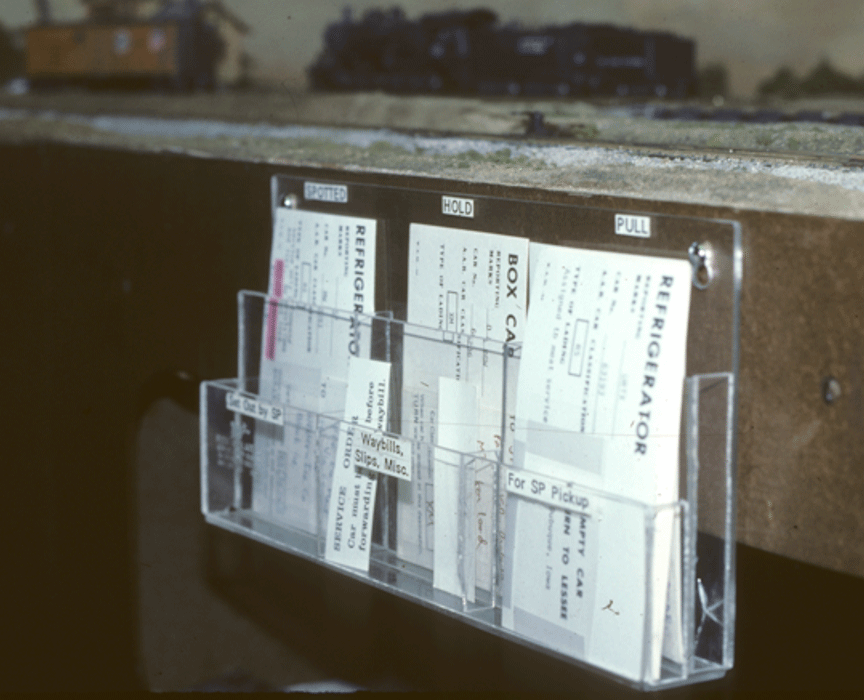
In some ways this is both simpler and more realistic for model operations. Years ago, when I used the 3 x 5 car cards of the Doug Smith-Allen McClelland type, I had built clear plexiglass racks for car cards, which hung on the side of the layout like this:
They also prepared waybills for newly loaded cars, and handed both kinds of bills to the crew which would pick up those cars. And if there was an empty which could usefully be “confiscated” (as it is termed) for loading, instead of sent homeward by the reverse of its inbound route under load, the agent makes that decision and informs the crew.
All these duties are included among the jobs described in my article in the October 2011 issue of The Dispatcher’s Office, the OpSIG magazine, and a corrected version of that article (to remedy errors which arose in the production process) is available via Google Docs, with a link in my post on this topic, at http://modelingthesp.blogspot.com/2011/09/my-article-in-dispatchers-office.html.
In modeling, the job of local agent is usually combined with that of operator, so that train orders or other operational paperwork can also be handled. But on many railroads, including the SP, jobs designated as agent-operator, that is, with combined duties, were rare. If an agent was needed at a station, normally it was because there were sufficient agent’s duties, and agents usually worked a daylight shift. Operators, on the other hand, if at a busy location, could well work all three shifts.
On some layouts, the job of agent may also have duties such as selecting waybills to simulate shipper demand for cars, though in my system that is handled separately from any agent (and of course on the prototype, the shippers, not the agents, created demand). But the core duty is receiving waybills from crews who are delivering loaded cars, and providing waybills and Empty Car Bills for cars being picked up, and directions for car confiscation, if any.
What if there is no space in the layout room for an agent at a town which would otherwise require one? The person acting as agent can, of course, show up only when a crew needs paperwork to be handled. But an alternative is the use of a “bill box.” This is a box, on the outside of the depot at many prototype locations, locked with a switch padlock. If no agent is on duty, the crew can open the bill box and acquire any paperwork left for them (along with messages which may be needed to direct their work), and on departure can leave behind any paperwork destined to the agent.
In some ways this is both simpler and more realistic for model operations. Years ago, when I used the 3 x 5 car cards of the Doug Smith-Allen McClelland type, I had built clear plexiglass racks for car cards, which hung on the side of the layout like this:
This rack had “SPOTTED,” “HOLD,” and “PULL” slots, and at front were pickup and setout slots, and a holder for service slips, completed waybills, etc. But now with the use of a bill box, this can be eliminated. Today it looks like this:
Of course a filing system inside the box is still necessary to keep industries separate and so forth, but no rack intrudes into the aisle, and bills are out of sight.
Both photos show the same town (now called Shumala), and there is a long shelf under the town for tools, soft drink cans, etc., which nicely accommodates the box. Formerly the rack was at the other end of the same shelf. When I operate a cycle of switching by myself (a wonderfully soothing process, by the way), I can use the paperwork system in the box, and if a visiting crew is doing the work, they too simply use the box if no one is designated as agent.
Some of the details of how the agent’s job works will require discussion of my system of “demand-based” waybill flow, that is, how the waybills are selected in the first place, based on shipper demand. Posts on that subject are forthcoming. But this post summarizes the basic agent’s job as I see it.
Tony Thompson
Both photos show the same town (now called Shumala), and there is a long shelf under the town for tools, soft drink cans, etc., which nicely accommodates the box. Formerly the rack was at the other end of the same shelf. When I operate a cycle of switching by myself (a wonderfully soothing process, by the way), I can use the paperwork system in the box, and if a visiting crew is doing the work, they too simply use the box if no one is designated as agent.
Some of the details of how the agent’s job works will require discussion of my system of “demand-based” waybill flow, that is, how the waybills are selected in the first place, based on shipper demand. Posts on that subject are forthcoming. But this post summarizes the basic agent’s job as I see it.
Tony Thompson
Thursday, October 27, 2011
Waybills, Part 14
In a previous post on this topic (Waybills-7), I described some tentative steps toward waybilling “through” cars, that is, cars which are moving from staging to staging and do not have any activity on the layout beyond movement in a through train. That post is visible at: http://modelingthesp.blogspot.com/2011/05/waybills-7.html.
The green “through” bills described in Waybills-7 are in fact in use, but I am beginning to replace them with true waybills, which carry off-layout origins and destinations. Some of the ideas for these have originated in the work done on Otis McGee’s waybills. Since his layout is heavily oriented toward bridge traffic, numerous waybills have been created (or are in the process of being created), and in many cases the loads represent cargo which may have moved over the Coast Line, and can thus be used as through bills on my own layout.
Most of the shipper-consignee pairs being identified are derived from the OpSIG (Operations SIG of NMRA) database, which is available at their website, www.opsig.org, under “Online Resources,” and then “Industry Database.” In addition, I am using the reprinted Shipper Guides for GN, RI, D&RGW, UP, Mopac, T&P and Milwaukee Road (some of their info is already entered in the OpSIG database). All these except the D&RGW are available through Rails Unlimited (website: http://railsunlimited.ribbonrail.com/ ).
As I’ve mentioned in connection with the waybills for Otis, it’s possible to operate cars in both directions loaded, or in both directions empty, just by choosing the paperwork for that car, in addition to the perhaps-obvious cycle in which a car is loaded one way, empty the other. (This of course only works for closed cars, as an open-top car is visibly either loaded or not.)
For example, a waybill for a cargo such as can-closure machinery, from Consolidated Canning, Atlanta, Georgia, to Oregon Cherry Producers, Salem, Oregon, routed via the Southern to New Orleans, then via T&NO and SP, could well move via the Coast (as well as the Shasta Division), and could be used on either layout. Here is the original waybill for the Shasta Division:
Here is the corresponding bill for my layout, also as a through car, with a different type face used:
Both bills are of course Southern Railway in origin and the bill header reflects this. An important difference between the two is that the McGee bill specifies a particular car in which the load is carried. My bill can be assigned to any XM car for which I have a car sleeve.
Here’s a perishable bill which represents through traffic on Otis’s layout, again with a specific car identified in the waybill for the “car-card-free” system Otis is adopting, and one which could readily be re-made for the system on my layout.
As another example, I have the Adam-Hill Company, a South San Francisco distributor of mechanical power transmission parts, along with bearings, hoses, tubing and fittings. In the 1950s, Adam-Hill received some of its material by rail. Among their long-time suppliers is Warner Electric Brake Company, located in South Beloit, Illinois (near the Wisconsin border), on the Milwaukee Road. Shipments directly west on the Milwaukee through the Pacific Northwest might well come southward on the Shasta Division (a through load for Otis) or might move via St. Louis to unload a partial shipment at Los Angeles (a through load for me). Another possibility might be Union Gear & Sprocket in Pawtucket, Rhode Island on the New Haven, another long-time Adam-Hill supplier.
Here is a Milwaukee Road waybill of a Warner load for Otis:
These examples should suffice to indicate the kinds of waybills being created at present for through cars.
I am still exploring ways to make Otis’s through waybills more flexible, because they can in principle be applied (and in my view should be applied) to multiple cars on the layout. I will probably simply reprint some waybills several times, each with a different box car number on it, and we will see how that works in operating sessions.
Tony Thompson
The green “through” bills described in Waybills-7 are in fact in use, but I am beginning to replace them with true waybills, which carry off-layout origins and destinations. Some of the ideas for these have originated in the work done on Otis McGee’s waybills. Since his layout is heavily oriented toward bridge traffic, numerous waybills have been created (or are in the process of being created), and in many cases the loads represent cargo which may have moved over the Coast Line, and can thus be used as through bills on my own layout.
Most of the shipper-consignee pairs being identified are derived from the OpSIG (Operations SIG of NMRA) database, which is available at their website, www.opsig.org, under “Online Resources,” and then “Industry Database.” In addition, I am using the reprinted Shipper Guides for GN, RI, D&RGW, UP, Mopac, T&P and Milwaukee Road (some of their info is already entered in the OpSIG database). All these except the D&RGW are available through Rails Unlimited (website: http://railsunlimited.ribbonrail.com/ ).
As I’ve mentioned in connection with the waybills for Otis, it’s possible to operate cars in both directions loaded, or in both directions empty, just by choosing the paperwork for that car, in addition to the perhaps-obvious cycle in which a car is loaded one way, empty the other. (This of course only works for closed cars, as an open-top car is visibly either loaded or not.)
For example, a waybill for a cargo such as can-closure machinery, from Consolidated Canning, Atlanta, Georgia, to Oregon Cherry Producers, Salem, Oregon, routed via the Southern to New Orleans, then via T&NO and SP, could well move via the Coast (as well as the Shasta Division), and could be used on either layout. Here is the original waybill for the Shasta Division:
Here is the corresponding bill for my layout, also as a through car, with a different type face used:
Both bills are of course Southern Railway in origin and the bill header reflects this. An important difference between the two is that the McGee bill specifies a particular car in which the load is carried. My bill can be assigned to any XM car for which I have a car sleeve.
Here’s a perishable bill which represents through traffic on Otis’s layout, again with a specific car identified in the waybill for the “car-card-free” system Otis is adopting, and one which could readily be re-made for the system on my layout.
As another example, I have the Adam-Hill Company, a South San Francisco distributor of mechanical power transmission parts, along with bearings, hoses, tubing and fittings. In the 1950s, Adam-Hill received some of its material by rail. Among their long-time suppliers is Warner Electric Brake Company, located in South Beloit, Illinois (near the Wisconsin border), on the Milwaukee Road. Shipments directly west on the Milwaukee through the Pacific Northwest might well come southward on the Shasta Division (a through load for Otis) or might move via St. Louis to unload a partial shipment at Los Angeles (a through load for me). Another possibility might be Union Gear & Sprocket in Pawtucket, Rhode Island on the New Haven, another long-time Adam-Hill supplier.
Here is a Milwaukee Road waybill of a Warner load for Otis:
These examples should suffice to indicate the kinds of waybills being created at present for through cars.
I am still exploring ways to make Otis’s through waybills more flexible, because they can in principle be applied (and in my view should be applied) to multiple cars on the layout. I will probably simply reprint some waybills several times, each with a different box car number on it, and we will see how that works in operating sessions.
Tony Thompson
Monday, October 24, 2011
Meeting highlights, Lisle
The Railroad Prototype Modelers meeting, hosted for 16 years by Martin and Patricia Lofton (of Sunshine Models) at the Holiday Inn in Naperville, Illinois, changed hosts last year, to Joe D’Elia of A-line Products. That hotel then closed for complete renovation, and this year’s meeting, the 18th, was at the Hickory Ridge Marriott Hotel in Lisle, Illinois, a town adjoining Naperville. It appears likely that next year we will be back at the previous location, with the hotel now becoming a Marriott.
This year’s meeting was very good, in my estimation (I believe I have attended all but three of these meetings). The vendor rooms were generously sized and there were a great many vendors, with many chances to have a look at products not in every hobby shop--and of course to purchase the irresistible ones. The display room was large enough for perhaps two dozen display tables (I didn’t count them), containing hundreds of outstanding models, and two large modular layouts. But as always, a major part of the meeting is the clinic program.
This year, there were four parallel clinic tracks, in four rooms. There were six time slots on Thursday and Saturday, seven on Friday, making 76 clinic slots in all. Most talks were given twice, so this means at least 38 different talks. I won’t attempt to describe them all, or even all the ones I attended, but will indicate several that I thought were outstanding.
Steve Hile gave a fine talk about the Bettendorf Company, its founders and its history, as well as what survives today. Clark Propst gave one of those presentations I’d like to see for many railroads: “M&StL Freight Cars You Should Build.” He showed a lot of models and how to create them. Jack Burgess, dependably an outstanding speaker, talked about tools for model building. Of course we all own a certain number of tools, but believe me, Jack is in a somewhat different league when it comes to serious tools and clever ways to use them. Martin Lofton talked about box cars which had been converted from automobile cars, and yes, as he freely admitted, it was a promo for several of his Sunshine kits, but well presented and informative.
I always like to hear updates from our fine freight car modelers, on what they are doing recently (Clark’s talk was in that direction), and so I enjoyed Mont Switzer’s presentation on his recent projects, and Dick Harley’s clinic on modeling PFE mechanical reefers. An excellent slice of freight car history was contained in Ed Hawkins’ talk on Bethlehem 70-ton drop-end gondolas, which of course is in written form in the new Railroad Prototype Cyclopedia issue no. 23, but it was intriguing to see the entire thing as an oral presentation. Both Richard Hendrickson and Andy Sperandeo gave fine talks about making “ready to run” models really ready to run, involving correction of minor detail parts and trucks, and particularly weathering and addition of such details as chalk marks and reweigh and repacking dates.
I’m saving for last the talks that were the most intriguing for me, with my recent explorations of waybills for model layouts. Perry Sugarman gave a really thought-provoking clinic on “Prototypical Car Movements with Realistic Documents,” showing his computer technique, using Microsoft Access, to handle paperwork for Dan Holbrook’s large layout. You can in fact download the slides from Perry’s talk at his website, at: http://www.perryaire.net/RPM2011 but be aware that it’s a big file and will take a little time to download. From his home page you need to click on “Trains” and then on “Waybills,” then at the top of page, click on “RpmLisle2011” and finally on “Car Cards.”
The other talk I especially valued was Dan Holbrook’s talk on “Car Service Rules 1940-1960.” (It too is available on Perry’s website; follow the directions above but when you get to the “RpmLisle2011” page click instead on “Car Service Rules.”) Dan is still working as a BNSF Yardmaster and has worked for the railroad since the early 1970s, so with that wealth of experience, you really have to listen to what he says; theory it’s not. This was a great summary of all the Car Service aspects most of us understand only dimly. Hopefully my grasp is now a little less dim.
There were numerous other talks, but several were ones I had heard before, so did not sit in again. My own presentations were on “Improving Waybills: Adapting Prototype Paperwork,” aspects of which have been posted in this blog, and a joint talk with Richard Hendrickson on “Weathering Freight Cars.” Our handout is really only a summary of tools and materials, but it’s available at this link: http://modelingthesp.blogspot.com/2011/10/weathering-clinic-handout.html.
Another aspect of the meeting was the “Friends of the Freight Car” activities, both in selling the new shirts and in the dinner that was held at the hotel, but that is summarized separately, at: http://modelingthesp.blogspot.com/2011/10/friends-of-freight-car-2.html .
Last but not least, this meeting, along with the January meeting at Cocoa Beach, Florida, is a great chance to meet modelers from all over the country, some of whose names you will know from the Internet but can now put a face with the name--and of course get a chance to chat. And many old acquaintanceships can be renewed, always a pleasure.
I greatly enjoyed many of the talks I heard, along with the excellent vendor rooms, the fellowship, and the superb modeling display, and would (as usual) rate this meeting as high as any I attend in a year. If you have never been to a Naperville meeting, think about it next year. I’m sure you will be impressed with the experience.
Tony Thompson
This year’s meeting was very good, in my estimation (I believe I have attended all but three of these meetings). The vendor rooms were generously sized and there were a great many vendors, with many chances to have a look at products not in every hobby shop--and of course to purchase the irresistible ones. The display room was large enough for perhaps two dozen display tables (I didn’t count them), containing hundreds of outstanding models, and two large modular layouts. But as always, a major part of the meeting is the clinic program.
This year, there were four parallel clinic tracks, in four rooms. There were six time slots on Thursday and Saturday, seven on Friday, making 76 clinic slots in all. Most talks were given twice, so this means at least 38 different talks. I won’t attempt to describe them all, or even all the ones I attended, but will indicate several that I thought were outstanding.
Steve Hile gave a fine talk about the Bettendorf Company, its founders and its history, as well as what survives today. Clark Propst gave one of those presentations I’d like to see for many railroads: “M&StL Freight Cars You Should Build.” He showed a lot of models and how to create them. Jack Burgess, dependably an outstanding speaker, talked about tools for model building. Of course we all own a certain number of tools, but believe me, Jack is in a somewhat different league when it comes to serious tools and clever ways to use them. Martin Lofton talked about box cars which had been converted from automobile cars, and yes, as he freely admitted, it was a promo for several of his Sunshine kits, but well presented and informative.
I always like to hear updates from our fine freight car modelers, on what they are doing recently (Clark’s talk was in that direction), and so I enjoyed Mont Switzer’s presentation on his recent projects, and Dick Harley’s clinic on modeling PFE mechanical reefers. An excellent slice of freight car history was contained in Ed Hawkins’ talk on Bethlehem 70-ton drop-end gondolas, which of course is in written form in the new Railroad Prototype Cyclopedia issue no. 23, but it was intriguing to see the entire thing as an oral presentation. Both Richard Hendrickson and Andy Sperandeo gave fine talks about making “ready to run” models really ready to run, involving correction of minor detail parts and trucks, and particularly weathering and addition of such details as chalk marks and reweigh and repacking dates.
I’m saving for last the talks that were the most intriguing for me, with my recent explorations of waybills for model layouts. Perry Sugarman gave a really thought-provoking clinic on “Prototypical Car Movements with Realistic Documents,” showing his computer technique, using Microsoft Access, to handle paperwork for Dan Holbrook’s large layout. You can in fact download the slides from Perry’s talk at his website, at: http://www.perryaire.net/RPM2011 but be aware that it’s a big file and will take a little time to download. From his home page you need to click on “Trains” and then on “Waybills,” then at the top of page, click on “RpmLisle2011” and finally on “Car Cards.”
The other talk I especially valued was Dan Holbrook’s talk on “Car Service Rules 1940-1960.” (It too is available on Perry’s website; follow the directions above but when you get to the “RpmLisle2011” page click instead on “Car Service Rules.”) Dan is still working as a BNSF Yardmaster and has worked for the railroad since the early 1970s, so with that wealth of experience, you really have to listen to what he says; theory it’s not. This was a great summary of all the Car Service aspects most of us understand only dimly. Hopefully my grasp is now a little less dim.
There were numerous other talks, but several were ones I had heard before, so did not sit in again. My own presentations were on “Improving Waybills: Adapting Prototype Paperwork,” aspects of which have been posted in this blog, and a joint talk with Richard Hendrickson on “Weathering Freight Cars.” Our handout is really only a summary of tools and materials, but it’s available at this link: http://modelingthesp.blogspot.com/2011/10/weathering-clinic-handout.html.
Another aspect of the meeting was the “Friends of the Freight Car” activities, both in selling the new shirts and in the dinner that was held at the hotel, but that is summarized separately, at: http://modelingthesp.blogspot.com/2011/10/friends-of-freight-car-2.html .
Last but not least, this meeting, along with the January meeting at Cocoa Beach, Florida, is a great chance to meet modelers from all over the country, some of whose names you will know from the Internet but can now put a face with the name--and of course get a chance to chat. And many old acquaintanceships can be renewed, always a pleasure.
I greatly enjoyed many of the talks I heard, along with the excellent vendor rooms, the fellowship, and the superb modeling display, and would (as usual) rate this meeting as high as any I attend in a year. If you have never been to a Naperville meeting, think about it next year. I’m sure you will be impressed with the experience.
Tony Thompson
Friends of the Freight Car, Part 2
My previous post describing what the Friends of the Freight Car represents, and how it came about, had a full history of the shirts. Here’s a link:
http://modelingthesp.blogspot.com/2011/10/friends-of-freight-car.html
I should mention another piece of the FOTFC history, which I failed to include in the previous post. After that initial dinner in 1990, a group photo was published in Railmodel Journal (November 1990, page 4). The editor, Bob Schleicher, was at the dinner and included in the photo caption not only the identities of everyone in the photo, but also listed the invitees who had not been able to attend, something I should have done in my original post. Here they are: John Armstrong, Scott Chatfield, Jim Eager, Martin Lofton, Terry Stuart, and Mont Switzer.
Another iteration of the Friends of the Freight Car dinner was held at the Lisle, Illinois meeting on the evening of Thursday, October 20. It took place in the Marriott hotel at which we met, and Richard Hendrickson acted as MC. After dinner, Bill Schneider of Rapido was the dinner speaker. He gave us some background and insight into Rapido as a company, and talked about the production process for models, including freight cars. It was a very good after-dinner talk, in that it wasn’t too intense and had some humor from place to place. And for those not aware of how model production is conducted in China, it was a very interesting description of the problems and benefits of that process.
Richard and I, as ongoing hosts of the FOTFC dinner in a variety of previous venues, felt that this one went very well. We had a good meal from the hotel, the speaker was quite effective, and best of all, we didn’t have to organize the meal itself or deal with finances. Those aspects were handled as part of the overall convention by Joe D’Elia, and everything worked very smoothly. We are certainly open to future dinners in this mode.
Present plans are to have an even less-formal meal at the Cocoa Beach meeting in January, likely a buffet lunch at the hotel. As in the original idea of these meals, it is really intended to be a socializing occasion for freight car enthusiasts, both experienced and novice, and there is no agenda beyond that. The limited time span available to eat lunch means that we will not have a speaker or any other formalities.
I welcome the revival of these get-togethers for those of us who concentrate on freight cars in our modeling.
Tony Thompson
http://modelingthesp.blogspot.com/2011/10/friends-of-freight-car.html
I should mention another piece of the FOTFC history, which I failed to include in the previous post. After that initial dinner in 1990, a group photo was published in Railmodel Journal (November 1990, page 4). The editor, Bob Schleicher, was at the dinner and included in the photo caption not only the identities of everyone in the photo, but also listed the invitees who had not been able to attend, something I should have done in my original post. Here they are: John Armstrong, Scott Chatfield, Jim Eager, Martin Lofton, Terry Stuart, and Mont Switzer.
Another iteration of the Friends of the Freight Car dinner was held at the Lisle, Illinois meeting on the evening of Thursday, October 20. It took place in the Marriott hotel at which we met, and Richard Hendrickson acted as MC. After dinner, Bill Schneider of Rapido was the dinner speaker. He gave us some background and insight into Rapido as a company, and talked about the production process for models, including freight cars. It was a very good after-dinner talk, in that it wasn’t too intense and had some humor from place to place. And for those not aware of how model production is conducted in China, it was a very interesting description of the problems and benefits of that process.
Richard and I, as ongoing hosts of the FOTFC dinner in a variety of previous venues, felt that this one went very well. We had a good meal from the hotel, the speaker was quite effective, and best of all, we didn’t have to organize the meal itself or deal with finances. Those aspects were handled as part of the overall convention by Joe D’Elia, and everything worked very smoothly. We are certainly open to future dinners in this mode.
Present plans are to have an even less-formal meal at the Cocoa Beach meeting in January, likely a buffet lunch at the hotel. As in the original idea of these meals, it is really intended to be a socializing occasion for freight car enthusiasts, both experienced and novice, and there is no agenda beyond that. The limited time span available to eat lunch means that we will not have a speaker or any other formalities.
I welcome the revival of these get-togethers for those of us who concentrate on freight cars in our modeling.
Tony Thompson
Weathering clinic handout
At the just-concluded Lisle meeting, Richard Hendrickson and I did a joint clinic on weathering of freight cars. I talked for 30 minutes about my acrylic washes and related methods, and Richard spoke for the same time span about mostly airbrushing, but with added comments about his use of pencils, washes and chalks. I will probably post some of the content of my part of this presentation on this blog, but the immediate point is that we ran out of handouts, so I will post it here.
This handout is only intended to provide a brief summary of some materials and methods, obviously not a complete description, but it does provide a “takeaway” for those who saw the talk. We will also be doing it at Cocoa Beach in January, or so I understand, so there will be another chance to see it for those interested.
Here is the link to the document:
https://docs.google.com/viewer?a=v&pid=explorer&chrome=true&srcid=0Bz_ctrHrDz4wOTRhMWMxYzItODE2Mi00YzA1LTlmN2EtY2Q5YmYxNGEyMDNm&hl=en_US
I will also post some comments about the rest of the Lisle meeting in the near future.
Tony Thompson
This handout is only intended to provide a brief summary of some materials and methods, obviously not a complete description, but it does provide a “takeaway” for those who saw the talk. We will also be doing it at Cocoa Beach in January, or so I understand, so there will be another chance to see it for those interested.
Here is the link to the document:
https://docs.google.com/viewer?a=v&pid=explorer&chrome=true&srcid=0Bz_ctrHrDz4wOTRhMWMxYzItODE2Mi00YzA1LTlmN2EtY2Q5YmYxNGEyMDNm&hl=en_US
I will also post some comments about the rest of the Lisle meeting in the near future.
Tony Thompson
Subscribe to:
Posts (Atom)