Showing posts with label Industry. Show all posts

Friday, July 3, 2026

My state highway facility

Among the many industries in my layout town of Ballard is a facility of the California Division of Highways, predecessor of today’s CalTrans. I chose this regional facility in part to be able to receive cement cargoes in covered hoppers. In the year I model, 1953, covered hoppers were almost entirely used for bulk cement. Many of their cargoes, familiar in later years, such as dry chemicals, grain, animal feed, and so forth, were mostly in the future in 1953. 

The cement loads are appropriate because in 1953, the Division of Highways continued to build and maintain many secondary roads and bridges in the state. The advent of freeways after 1940, usually enormous projects, had made contractors essential in major works, but local roads and highways were still the responsibility of the Division of Highways. Thus inbound cargoes of both cement and asphalt are appropriate, along with all kinds of supplies like fence and sign posts, rebar, bridge girders, lumber for concrete forms, and so on. 

I built the structure from a Rix Pikestuff kit (intended as an auto repair garage), a simple styrene kit that went together easily. It represents a cinder-block building with steel-framed windows. As I built it, it has a 3.5 x 7-inch footprint. I went online and researched the geographic districts of the Division of Highways in 1953, and found that the Central Coast area I model was in District 5.

As stated above, my primary motivation for including this industry was inbound cement loads. So the classic view you would have of this industry in most of my operating sessions is as below. That’s Nipomo Street at left.

In addition to the cement loads and other highway materials mentioned above, occasionally some work equipment may arrive. In the photo below, it’s a road grader. 

In creating waybills for this destination, I knew that cement, a heavy and not particularly expensive commodity, ordinarily does not travel far from  origin. It is easy online to research what cement plants existed in California in 1953, and I show a partial list below. I’ve omitted a few, such as the Calaveras Cement plant at San Andreas, on SP’s Kentucky House branch.

One feature of the list above is that one of the plants, Southwestern Portland Cement, was located on the Santa Fe. This provides a reason for inbound Santa Fe freight cars on my layout. Given the often-fierce rivalry between SP and Santa Fe, empty Santa Fe cars would effectively never be loaded on the SP, but of course inbound loads could well travel in them.

For waybills, there is nothing exotic about the ones for this industry. I show an example below. And in addition to the occasional Santa Fe covered hopper with such loads, I can also use T&NO, SSW, and UP cars, all of which would be available in California for loading at the plants above. 

This industry, like a number that are on my layout, was chose specifically for the loads it would receive, and has worked well in that capacity.

Tony Thompson 

Sunday, May 10, 2026

Beer as an industrial commodity, Part 2

Long-time readers of this blog, or those who may have heard a clinic I have given several times, may find that the title of the present post stirs a memory. That’s because those prior blog posts and clinics were entitled “Wine as an industrial commodity,” a topic I developed jointly with my late friend Richard Hendrickson. Here’s a link to that earlier post: https://modelingthesp.blogspot.com/2012/02/wine-as-industrial-commodity.html

More recently, I took the railroad side of that topic and reorganized the material as an article for Model Railroad Hobbyist, the on-line magazine (see it at: www.mrhmag.com ). That article, entitled “Tank Cars and the Wine Business,” was in the May 2023 issue of MRH, and I posted some comments about it (see: https://modelingthesp.blogspot.com/2023/05/my-column-in-may-2023-model-railroad.html ).

I suppose it’s natural to consider the ways in which beer can be viewed similarly, on the railroad side of the business, and how we can model some aspects of it, should we wish to do so. A few years ago, I wrote a post on this subject, giving the background of beer-making processes and materials (available at: https://modelingthesp.blogspot.com/2019/07/beer-as-industrial-commodity.html ). 

In this present post, I want to visit some additional points, particularly relating to the the rail traffic that goes with beer. In doing so, I will overlap somewhat with that previous post.

By the late 20th century, a very few huge brewing companies dominated the beer business in the United States, and it’s perhaps difficult to realize that only as far back as 1949, there were still 440 breweries in the U.S., the great majority of them relatively small and serving rather local territories. This is an advantage if you model that sort of era, because you don’t have to think about modeling the mammoth processing plants that breweries became later, or vast fleets of rail traffic. Rail traffic certainly did vary by era.

At the same time, these smaller breweries were not like the craft brewing operations of the last two decades, which get almost everything by truck. Instead, they were old-fashioned operations of little or no sophistication, but with rail service. So let’s look at what the rail traffic to and from such breweries would be.

We begin with the raw materials from which beer is made. The primary material is grain, traditionally barley, but possibly also wheat, corn, rice and others. The starches in the seed grains we harvest are converted to sugars at the time the seed germinates, to feed the new plant. So the grain used in making beer has to be made to begin germination and the conversion of starches to sugars. 

That process is called “malting” in the beer context, in which grains are dampened and warmed to begin germination, then heated to pause germination and dry the malt. The details of this process, especially the time and temperature of drying, can be varied over a wide range, and the starting grains also vary, producing a considerable variety of malts. This results in a wide range of beer colors and flavors (Briess Co. photo). 

In my previous post about beer, I went into some detail on malting at the industrial level, including rail car transportation, so I won’t repeat that part (here’s the link again: https://modelingthesp.blogspot.com/2019/07/beer-as-industrial-commodity.html).

Once malt is made and crushed or ground, it is treated with hot water to extract the sugars from the malt, and then the resulting liquid is brought to a boil and hops are added. Hops are a plant flower, and are dried before shipment. They contribute both flavor and resistance to spoilage to the beer (Sierra Nevada Brewing Co. photo). 

Next yeast is added to the liquid, nowadays a carefully chosen yeast, though for centuries brewers relied on “wild” yeasts that were in the environment. The yeast happily consumes the sugars, and their life-process waste product is alcohol. Under suitable controls, the result is beer.

A modern “factory” brewery would receive the starting ingredients, grain and hops, in bulk, and do everything needed for brewing in house. To make lighter beers, there might be little or no barley alongside the rice or corn malt. But for modern modeling, the point is that only raw materials would be shipped in.

In contrast, a smaller brewery might well receive malt instead of grain. Malt was often shipped in 50- or 100-pound paper bags, so it could arrive in box cars. Hops also were likely bagged in that era, though they were sometimes handled in bulk — again, box cars most likely for bagged hops.

Once beer is made, it is shipped out. The hundreds of small breweries of, say, 1949 mostly served a local area, so they would not have shipped much if any beer by rail. But even a medium-size brewery might do so. One’s first thought would involve box cars, but beer cans or bottles are quite subject to damage in transit. 

The introduction of load dividers for canned goods shipment was a huge step forward in reducing damage. For my 1953 era, this can include GAEX cars (see: https://modelingthesp.blogspot.com/2021/02/the-gaex-box-cars.html ),or the WP “feather’ box cars (here’s my recent post: https://modelingthesp.blogspot.com/2026/04/western-pacifics-famous-feather-box-cars.html ).  This is my GAEX model. 

So even if you don’t wish to model a brewery directly, you can model the rail traffic needed for one, either the raw materials inputs or the shipping of finished product. On my layout, both are included.

Tony Thompson 

Wednesday, March 11, 2026

Designing a switching layout

Recently a long-time friend, someone even older than me, asked advice about designing a switching layout he could build. He had limited space, didn’t want to do too much carpentry, but wanted some scope to do switching operations.

Now I’m really not a layout design guy, having only limited talent for visualizing how something would work. I admit my first thought, therefore, was to recollect one of the small layouts that I admired when it was first published, and which I’ve thought about it many times since. It is Model Railroader’s Beer Line layout, published as a layout construction article in the magazine issues from January to April 2009, with a follow-up article in May 2009 about operating schemes for the layout. 

An interesting aspect of this layout is that it was designed so it could be configured in several ways. As a layout with an oval of “mainline” track, it was 4 x 12 feet in size. But it was effectively made up of individual 2 x 4-foot sections, designed so they could be arranged in a variety of ways, such as a “J” shape or simply linear. As I recalled, some of the sections were able to be used in several ways. 

I went back to the MR articles and scanned in the track plan, then rearranged four of the two-foot-wide sections in what seemed like it would have a lot of switching. It’s shown below; you can click on the image to enlarge it, if you wish. (All MR images in this post used with permission.)

The industries shown on the drawing are the Milwaukee ones of the original design, but of course these can be changed to whatever is desired. The layout also has the Milwaukee River along the lower edge of the drawing, which can of course be omitted. Roads need not be located as shown, but could be relocated as desired. A nice feature is that there is a yard at one end. 

I have taken advantage of something in the original articles, tail tracks that can be removed, or hinged to fold down. These allow staging in those tracks, or in one case (at left edge in the drawing above), enough tail track to constitute a run-around. Below is a photo from the fifth article showing one of these in use. They could of course be as long as desired. 

Another point to recognize is that the original MR design was made so that the layout sections, however arranged, could be accessed from both sides. But a layout based on these ideas could well be located against a wall, making building flats on that side an attractive option to save space. If the upper edge of the drawing above were against the wall, several building flats could be served by an added track along the back.

The original MR article described building conventional legs and braces as support for the sections, as show roughly below. But my friend had two bookcases that he could put the layout on top of, each a little more than six feet long, so my 16-foot design shown above could simply by screwed or clamped to the top of the bookcases.  

My friend had also asked for some ideas of industries he should have. I promptly sent him the kind of list I personally have found effective, starting with the “universal industry,” the team track. Other very versatile industries are a wholesale grocer, a freight house, or a warehouse. Each can receive a wide variety of cargoes and freight car types. Freight houses can be long and narrow, as was the case on the Beer Line layout (below), or even as flats on the backdrop.

Beyond those choices, a beer and wine distributor is a possibility, along with a printer, a fuel dealer, and perhaps a cannery (fruit and/or vegetable). A chemical or pharmaceutical repackager could also be considered. Of course, any kind of manufacturing building, modeled only as a flat against the backdrop, could easily be added. These make possible a wide variety of car types to be switched to and from the industries. 

Tony Thompson 

Monday, December 15, 2025

My wholesale food warehouse at Ballard

One of the first industries I wanted to add to my original HO layout in Pittsburgh, PA was a warehouse for a wholesale grocer. This is a great industry for inbound loads, because everything from fruits and vegetables, to meat, poultry, eggs, and dairy products would arrive in refrigerator cars, and canned goods, other packaged foodstuffs, and dry goods could arrive in box cars, all logically to be delivered by rail. The possible waybills are practically innumerable.

My warehouse was scratchbuilt from heavy artist’s cardstock (walls are Bristol board) over a stripwood frame (mostly wood, some balsa). I made the frame heavy to ensure that the cardstock would remain flat. That’s shown below, looking into the interior. The building is 24 inches long and about 5 inches wide. The part nearest my hand is the “front,” that faces the siding, and the back wall, just visible here,  is blank because it can’t be seen from any angle, but does provide a view block.

I used a scriber to groove the Bristol board to look like sheathing planks. You can see above that one corner is cut off (lower right in the photo above) to fit the space on my previous layout. There is some additional description in this post: https://modelingthesp.blogspot.com/2012/05/survival-from-my-old-layout-2.html

The “business” side of the building has four numbered sliding doors, which can lead to requirements for “sure spots” by switch crews. (For background on that topic, see: https://modelingthesp.blogspot.com/2017/12/operating-with-sure-spots-part-3.html ). Doors are scratchbuilt, as is the inset loading dock; windows are Grandt Line. 

In the photo above you can see the business sign at the roof peak. It’s shown more clearly below. This lettering was printed with an “open” typeface, then hand colored. 

A view of this from one end (at a high angle, not accessible when standing on the floor of the layout room, shows the roofing and the distance from the backdrop. That’s the Zaca Mesa winery at right (for background, see: https://modelingthesp.blogspot.com/2025/11/my-zaca-mesa-winery.html ). 

Normally much of the the Peerless building is partly concealed by foreground structures, but getting up on a step stool allows a view like this, so that you can see the whole siding serving Peerless. The large reefer is from PFE’s first class of mechanicals (described in my RMC article in January 1988 and of course in the PFE book).

In-service views include ones like this, with a switcher spotting an MDT reefer. Note that one of the cars on spot is a box car, as mentioned in the introductory comments, above.

This has been a great industry for the layout, with lots of traffic inbound, involving a wide variety of foods and grocery staples, coming from all over the country. It’s wonderfully flexible and to me, endlessly interesting.

Tony Thompson 

Friday, December 5, 2025

My brass foundry in Ballard

From time to time, I post short descriptions of the industries on my layout, what they do, and how they form part of operating sequences. Today my subject is the Union Brass foundry in my layout town of Ballard. As a physical metallurgist before retirement, and who did thesis research on copper and brass, this is an industry I understand.

The building itself is built without much change from a Classic Miniatures kit, including the signage on the building front. But because the building front is oriented perpendicular to the layout edge and thus a little hard to read, I added the larger sign over the loading dock. This dock, by the way, was enlarged from the rather narrow one in the original kit. The model of the building represents a wood false front made to look like stone, something common in the century preceding the one I model. 

From the other side, you can see the furnace room addition. Also evident below is the near proximity on the right of the Jupiter Pump & Compressor facility. The idea here is that the brass foundry came into existence to supply brass plumbing parts for Jupiter.  

Part of what’s interesting about this building is the loads that are shipped in and out of it. Inbound may be bulk copper (and the foundry makes up the brass composition by adding zinc) or brass bar stock. Plumbing fixtures are shipped out, not only to Jupiter but to customers elsewhere. Sample waybills are shown below.
At left you see an inbound load of copper bar, shipped from Cananea in Mexico. As often happened at the Southern Pacific’s port of entry at Nogales, Arizona, Spanish language waybills were replaced by SP ones and the previous SP de Mexico waybill number shown (you can click to enlarge). The bill also shows that the car cleared customs at Nogales. At right is an outbound shipment bill, with a Transcontinental Freight Bureau weight agreement stamp on it.

Many loads arrive and depart in ordinary box cars, but an option is an occasional foreign box car, and I mean lierally foreign, from Mexico. The waybill shown above for an ASX car is the result of a custom decorated model years ago by Bev-Bel for a car owned by American Smelting & Refining (Asarco) in Mexico, and accordingly with dimensional and other data in metric as well as English units. 

I shouldn’t leave the impression that raw materials for this foundry come only from Mexico; the heart of the copper and brass businss in the 1950s, which I model, was in Connecticut, and this foundry more commonly receives loads from Bridgeport Brass (in Bridgeport) or Chase Brass & Copper (in Waterbury). 

This industry is different from others on the layout, in part because though it is a small structure, it also produces small parts in a simple casting process, and thus can realistically output carloads of product. So often on layouts (including my own) our models of industries are far too small to do the work we imagine them doing. This one is at least a little better in that regard.

Tony Thompson 


Wednesday, November 26, 2025

My Zaca Mesa winery

In my layout town of Ballard, there are two wine shippers, the larger of which is the Zaca Mesa winery. This is a large structure, made from a resin kit for a power house that I bought partly built, and then modified and completed. Here is the lid of the kit box, showing how the kit was intended to be built.

The upper photo above shows a receiving building at the right, for hopper cars of coal for the power plant. Since I wasn’t building it as a power plant, that annex was superfluous for me. I made it into the shipping building for a lemon packing business, and located it in a different town, Santa Rosalia. I modified the various openings with roll-up doors, especially the open archway on the end.

I also didn’t think the triple plain smoke stacks in the original power house kit were suitable for a winery, so replaced them with ventilators from my stash. More obviously, I changed the roof of the Magnuson building by giving it a tile roof, creating more of a California look.

In the foreground above, you can see my addition of a platform for loading tank cars (for details, see: https://modelingthesp.blogspot.com/2017/02/tank-car-loading-platforms-part-3.html ). A close-up of the platform also shows the building sign, shamelessly copying a real Zaca Mesa winery in Santa Ynez (Santa Barbara County); here’s their website: https://www.zacamesa.com/ ), though I didn’t copy their logo or building.

Lastly, the building has some loading doors, which are useful to me as the place that cars other than tank cars (more about that in a moment) can be loaded. The third photo from the top in this post shows a Class XT car (house car body with internal tanks) being loaded at these doors. 

The role of this winery in layout operation is conveyed by a background post of mine, about wine as an industrial commodity (see it at: https://modelingthesp.blogspot.com/2012/02/wine-as-industrial-commodity.html ) . There’s also an article in Model Railroad Hobbyist, in the issue for May 2023 (introduced at: https://modelingthesp.blogspot.com/2023/05/my-column-in-may-2023-model-railroad.html ). 

Wine grapes would be brought in from nearby vineyards, crushed and fermented, then aged to the desired degree. They can then be shipped out in bulk (in ordinary tank cars or XT cars) or packaged in bottles. As my modeling year of 1953 precedes widespread use of insulated box cars, un-iced reefers would be used for shipments of packaged wine.

I have always enjoyed having this industry on the layout, in part because it looks large enough to justify rail shipping at frequent intervals. Far too often, we model embarrassingly small industries, then regularly ship carloads to or from them. This one, at least, avoids that problem of scale.

Tony Thompson

Tuesday, September 9, 2025

Dealing with a short tail track

Some readers will remember that when I built my layout town of Santa Rosalia, I ended up with a pretty short tail track for switching the industries at the front of the layout. I had no real choice at the time, as the wall of the room was an immovable object. You can see this is the “plan view” below. The wall of the room is at right. 

From the three-way switch at lower left, the tail track is just the length of a 40-foot car and a single locomotive, such as the Southern Pacific Consolidation usually assigned to the local on this branch. Even a 50-foot car would not be workable here, if destined to the industries along the track at lower left.

Here is a level view, showing how the area looks, with the door frame to the right. 

More than once, during operating sessions, visiting operators have said, “Hey, this is simple to fix, just bore through the wall.” There is an adjoining room to the right, which was the kitchen when the layout space was a small apartment. Usually I laughed off the suggestion. But over time, I did think about doing it, and what I could accomplish on the other side of the wall. 

On the other side is the kitchen counter, with shelves above. On that counter, right next to the wall in question, is a microwave oven. The track could indeed be brought through the wall and extended across the top of the microwave. 

For some time, I had had thoughts of not only the extended tail track in the kitchen, but also of adding a new industrial spur, such as perhaps a shipyard. I have long had a casting of an industrial building, which I envisioned as a possible shipyard building on the extension of the branch trackage. It’s shown below on top of the microwave.

Completely coincidentally, the top of the microwave oven is almost exactly at the level of the track board on the other side of the wall. I attempted to photograph that, with the door partly open (and evident edge-on in the photograph below). You can see the two levels on each side. So there is a definite possibility that an extension through the wall could work. 

Just recently, I happened to look at it with a fresh eye, and thought that maybe I should consider the idea further. But my son, who does a lot of construction, checked the wall and determined that the door framing is double at this location, and that the track might not quite clear that framing. That could require some serious modifications to this doorway framing as part of a simple track extension. 

Not wanting to undertake all that, I decided to stand down. It’s too bad in a way, losing my vision of a shipyard industry to switch, along with the extended tail track, but no dice. Wish there was a happier outcome to report, but not on this one. The wall will remain whole.

 Tony Thompson 

Friday, November 25, 2022

Waybills, Part 103: timebook ads, conclusion

 As a wrap-up on what I regard as an interesting topic, the ads found in the timebooks used by train service employees, I want to show one more batch of these ads. I have written some comments on the background for timebooks, and on the ads and their use, for which I suggest the previous post in the series (see it here: https://modelingthesp.blogspot.com/2022/11/waybills-part-102-more-timebook-ads.html ).  

Most of the pages of ads that I will shown here are from a 1950 timebook for Southern Pacific’s Coast Division. As I have mentioned before, some are clearly aimed at railroaders’ personal lives, but others are interesting business ads.

Above you see ads for a savings and loan, and an auto dealership; but also some produce companies and San Jose’s FMC Corp., an obvious source of inbound waybills for any packing house or food handling business. Below are another two pages from this timebook:

In this pair of pages, there are again some obvious personal businesses, but also Pacific Hardware & Steel, along with the Western Pump Company we saw in the 1946 Coast timebook (link shown in the top paragraph of the present post).

Thirdly, I will show a single page from this 1950 Coast Division book (at right, below), and a single page from a 1948 Western Division book (at left).

 Once again, there are obvious personal-type ads (a clothing store and a drug store) but there is also an interesting logo for a concrete pipe company, Spiekerman, that could readily be used on a layout industry building, or as a placard on an open-car load. From these pages, though, I decided to make a waybill for the Gladding Bros. clay products company, to an on-line customer that uses a team track on my layout:

I continue to find these groups of ads in booklets used by train service employees very interesting, providing as they do a window into that world of some 70 years ago.  That they can also yield ideas for waybills in layout operation is simply a plus.

Tony Thompson


Saturday, November 19, 2022

Waybills, Part 102: More timebook ads

I explained in a previous post that often the timebooks used by train service employees were ones provided free by private printers, who paid for them with the ads they contained. The ads were sometimes directed at the personal life of railroaders (clothing stores, taverns, shoe stores, gas stations), but also were frequently the names of rail-served industries. I suppose these were for business good will. To see that post, use this link: https://modelingthesp.blogspot.com/2022/11/waybills-part-101-industries-from.html .

In the present post, I want to show a few pages from another Southern Pacific timebook, this one dating from the Coast Division in 1950. I have chosen the pages for their interest in realistic operation, minimizing the ones that are personal in nature. Here are two pages from the front and nearly the back of the book. (You can click on the image to enlarge it if you wish.)

Here there is really only one somewhat personal ad, the Hotel San Carlos at Monterey. We also have the General Box Co., two ice companies (I like the slogan, “ice never fails” in the National Ice ad, doubtless a swipe at possibly-less-dependable mechanical refrigeration), a vegetable grower at Guadalupe, and a farm machinery dealer. Here are two more pages:

These are especially interesting because of all the packing houses that felt the impulse to advertise to railroaders. And here is a third pair of pages, with some of the ads considerably smaller, but once again, a considerable number of packing houses:

This example happens to include a company that both built pumps, and also sold the pumps of others, doubtless for irrigation purposes. Since I have a company on my layout that builds specialty pumps, moving a few such pumps to the Western Pump Co. in San Jose would be appropriate. Here is how an illustrative waybill might look, drawn from this information.

These ads from vintage timebooks of the locale I model are excellent sources of information for me, but notice also, for all you modelers in faraway places from California, all the packing houses that can be shipping to your own layout’s on-line grocers or other receivers of produce. I have found these booklets not only quite interesting, but also valuable as sources of industry names.

Tony Thompson

Sunday, November 13, 2022

Waybills, Part 101: industries from timebooks

An ongoing problem in preparing realistic waybills for model railroad layout operation is the identification of the off-layout industries from which your on-layout industries receive loads, or the off-layout destinations for your on-layout shippers. One can of course make these up, if desired; but what if you would like to have actual ones to use?

I have written extensively about sources of such information; for links to some of those posts, I urge you to use the search box at right, or to consult my summary guide at: https://modelingthesp.blogspot.com/2022/11/waybills-part-100-guide.html .

A source I have not seen mentioned, but which I have used myself, are railroad employee timebooks. These were intended for train-service employees to record their trips, especially the time consumed on each trip, for payroll information. But often these books were non-railroad-issued documents, privately printed and provided free because they contained extensive ads. And it’s these ads that are of interest.

I will show a few examples. I particularly rely on several Southern Pacific Coast Division timebooks, but I have seen books from other divisions. Most of the ones like this that I have seen, are 5 x 8-inch upright books with cardstock covers; sometimes they are 4 x 7-inch upright books. Ads are sometimes only in extreme front and back pages, sometimes they border almost all pages. 

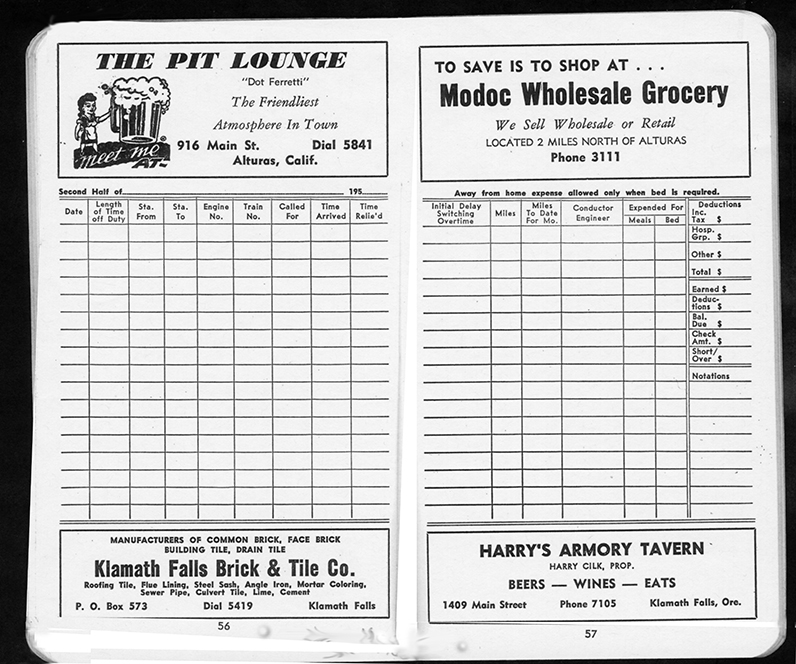
To illustrate, here is a blank Shasta Division 1946 timebook page spread (date known from the dates of the employee seniority lists elsewhere in the book). You can click on the image to enlarge it if you wish.

Note that the “business part” of the book is the blank entries for employee assignments. But note too the fascinating variety of ads, obviously some of them intended to appeal to a rail’s personal life (the tavern and the lounge). But note also the customer businesses (Klamath Falls Brick and Tile) and the businesses that might be both customers of the railroad, as well as serving its employees (the grocery).

Just to illustrate how a book like this was used, I show below two pages of Barry Anderson’s timebook for part of August 1953 on Coast Division. It’s a combination of yard jobs (all the ones noted as 8 hours) and road jobs. Barry sent me this copy. But this part of this book had no ads.

Usually at the front or back of these timebooks there would be included a division seniority list (one way we know the division of origin of each book). Shown below is another pair of pages from the 1946 Shasta Division book. The ads flank the list, and here they are all personally directed (who wouldn’t want to visit Ray’s Place?), though the Coca-Cola bottler might be rail-served.

For a contrasting example, I just show two pages (pages 2 and 54) from a 1948 SP Western Division timebook, pages chosen to emphasize railroad customers rather than the more personal ads (except of course the 704 Club at lower right, with the helpful information, “railroad pay checks cashed”). This is a 5 x 8-inch size book.

Can we use these? Absolutely. Just as an example, consider the Fruitvale Canning Co. of Oakland, with ad at lower left in the pages above. The fruits and vegetable they were canning were doubtless from the immediate East Bay and nearby Santa Clara Valley (long before it became known as Silicon Valley), but that wouldn’t preclude buying fruit from a little farther away if needed. Thus one could create a waybill something like this (as would fit my own layout);

I will show additional timebook ad pages in following posts, but the introductory description here helps explain what these are and how they might be used.

Tony Thompson

Sunday, July 17, 2022

My article in the July 2022 MRH

In the new issue of Model Railroad Hobbyist or MRH, dated July 2022, my article (part of the “Getting Real” series) is entitled “Fitting an Industry into a Tight Space.” It is about one of the last industries to be built for my layout, the imaginary Santa Rosalia Branch of the Southern Pacific. The industry is a kelp processing business, appropriate for the town of Santa Rosalia along the Pacific Ocean shore.

For a lot of years, I used the bottom part of a kit box, inverted, with the industry name lettered on the “top” of the box, to stand in for industries not yet built. Eventually I decided that was too prominent, so went to a simple paper slip with the industry name, placed about where the industry would go. The photo below (from the article) shows the site discussed in the article.

This is the spot where the new industry had to fit. You can see that most of the site, alongside Laguna Street right next to the fascia at the front of the layout, is just painted Homasote. The problem that I solved in the article was that the site is narrower than the kit that I chose to build.

I chose the “Carnegie St. Manufacturing” kit produce by my late friend Jim Sacco’s City Classics. I liked that it’s a cement-block building, of which I had none on the layout, and that it’s not “cute,” as are so many structure kits. Below is one of Jim’s photos of the kit, showing one way it can be built. It’s actually a fairly flexible kit, offering a number of possible configurations.

As I mentioned, my site is narrower than the City Classics kit, so I narrowed each of the end walls and then assembled the structure. Though this is fairly straightforward kit-bashing procedure, I showed each step in the article, in hopes of being perfectly clear about the simple steps needed. 

After assembling all four walls and one of the office extensions, along with painting windows and doors, the building looked like this from the back or track side (which is not viewable from the aisle of the layout). Roof is not yet painted, structure is not weathered.

Once the structure was weathered, signage added, and some Walthers “Roof Details” (set 3733) placed, it looked like this on the front side.

Finally, of course, the structure was placed on the layout and some scenic details added, along with a concrete driveway for the large delivery door and for parking at the far end. In the distance at right, you see the Santa Rosalia depot, one of SP’s distinctive Common Standard No. 22 structures, and in the background is the Martinelli Bros. fish cannery. 

The last point to be mentioned in the article was some detail about kelp processing and the various kelp products which would be shipped out of this building. I even included some sample waybills to illustrate the inbound and outbound loads. But I won’t repeat that discussion here.

This industry fills a gap on the layout, and in the group of marine-oriented industries here in coastal Santa Rosalia. I’m glad to have it on the layout.

Tony Thompson

Tuesday, October 19, 2021

Chromite mining on my layout

A few years back, I wrote a description of the kinds of published information that a modeler can use to find out about mining activities in a particular area being modeled. Of course, if you are modeling West Virginia or the Mesabi Range, you are not in doubt about mining issues, but there were more modest mining areas throughout the country. That post can be found here: https://modelingthesp.blogspot.com/2016/10/modeling-mining-in-your-locale.html

I followed up that post, which ended up describing a little about chromite mining in California, with more information about the mineral itself, and some progress I had made in making ore cars and suitable loads. (See that post at this link: https://modelingthesp.blogspot.com/2016/10/modeling-mining-part-2.html ). In the present post, I return to this topic. 

I have chosen the name of an actual mining operation in the vicinity of my layout locale, Monarch Mining, as the shipper of ore, ordinarily the kind of “disseminated” ore described in the post cited in the first paragraph, above. This ore contains a moderate amount of the target mineral, chromite, in a matrix of serpentine. 

I envision this ore being en route to a facility that refines the ore to separate the chromite, and then makes high-temperature refractory brick, one type of which includes chromite in the brick composition. 

And just to repeat what I’ve said before, the term “ore” is an economic one: it means a mineral that can be economically mined and refined for use. The identical mineral that is more difficult to mine, transport, or refine would no longer be considered an ore.

To transport chromite ore on my layout, I have continued to work on 70-ton ore cars, as I showed in the post just cited, and have increased the size of the fleet. But where would ore come from? Despite the fact that having “a mine” on a layout is a cliche dating back 80 years or  more in the hobby, I don’t have one and don’t want or need one. Instead, I could model a truck dump; or simply let the mining company load cars at a team track.

So even in the absence of a truck dump on the layout, loaded and empty Monarch ore cars can be seen, for example as in this photo at Shumala. These cars, MMCX 217 and 241,  are evidently waiting for pickup by the next SP local.

As I have mentioned in previous posts, I also used a Grandt Lines kit for a Gilpin Tram ore car, simply adding HO scale detail parts, trucks and couplers to the O-scale car body. This makes a more reasonable size ore car for my use. I have one of them labeled for Monarch Mining, as you see below in another cut of ore loads at Shumala, waiting for pickup.

In addition to these carloads of ore, Monarch would presumably receive various kinds of repair parts and supplies for its mining operation. These can be directed to a team track for the time being, until I can figure out where to add an office or warehouse for Monarch on the layout. Or, of course, like many industrial users of rail shipment, there really need be no Monarch building visible anywhere on the layout, with any shipments going via team track. 

Here’s an example waybill to represent such an inbound shipment. The Hardinge Company, headquartered in York, PA,  was and is a real concern that once manufactured many kinds of equipment including mining and milling equipment. Today they specialize in metal cutting equipment. They continue to have warehouses all over the world; in the transition era one was in Salt Lake City.

Here is a photo of the shipment just described, being spotted on the team track in Ballard on my layout. I have shown this load previously, in a post about removable loads, especially crates, for open-top freight cars  (see it at: https://modelingthesp.blogspot.com/2012/03/open-car-loads-crates-and-machinery.html ).

So as I have mentioned before in several places in this blog, I do represent mining on my layout, despite the fact that California in this or the previous century wouldn’t be considered a major mining state; and I neither intend nor want to model an actual mine on the layout. I just depict the traffic.

Tony Thompson