Wednesday, March 30, 2022

SoundRail 2022

 Two years ago, in early March 2020, I and many others had plane reservations, hotel reservations, and a sign-up for the semi-annual Seattle-Tacoma area event, SoundRail. But of course the pandemic exploded, the event was cancelled, and we entered the long shut-down of most operating sessions. But now it’s 2022, an even-numbered year, normal schedule for SoundRail. This time, the event did take place, and I was delighted to be there.

The three-day event meant operating on three layouts, plus a “pre-event” event on the Thursday beforehand added a fourth layout. I was lucky enough to get signed up for Joe Green’s “Ryder Gap Subdivision” HO scale layout for the pre-event, a C&O layout set in 1974 in the mountains of Virginia. This is a beautiful layout, with superb structures, and everything ran very nicely.

The job I had here was the Mill Gap Turn, and shown below is our train, starting switching at Mill Gap. This was very enjoyable because of the handsome structures, and also the extensive switching required. I admire a layout with industries modeled as big enough to justify the number of freight cars we send there.

I should also mention the freight cars. I was struck by how much careful attention to weathering is evident in the entire freight car fleet. I will just show one example, clearly reflecting observation of the prototype, a C&O gondola with typical rust pattern inside: partway up the sides. Nicely done!

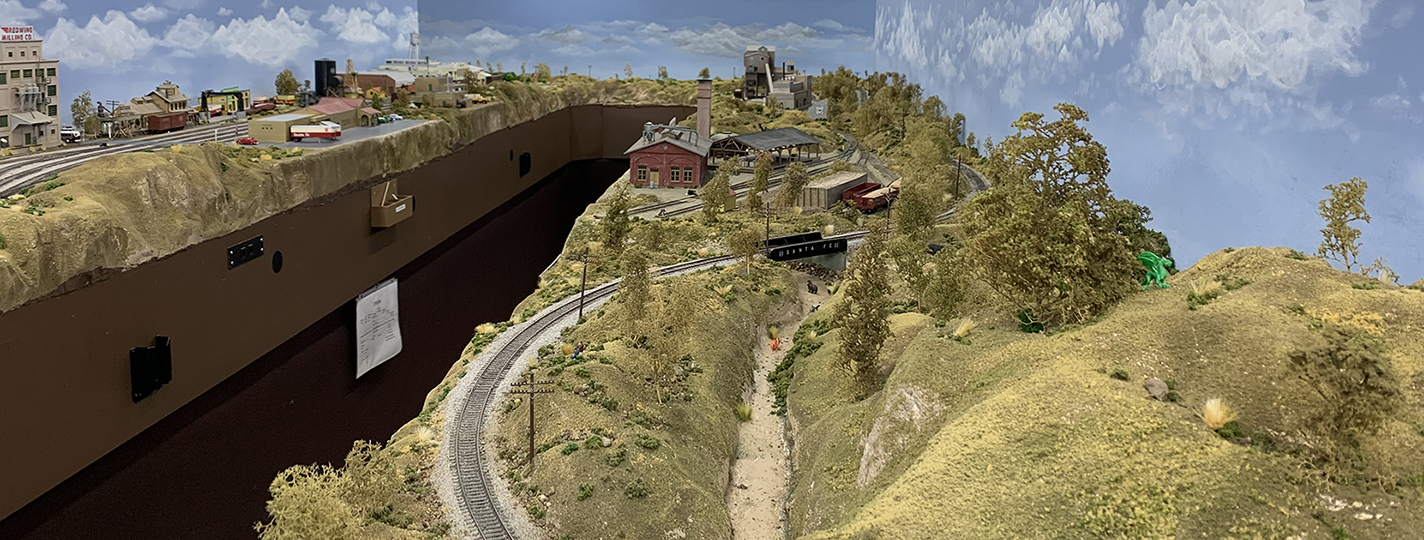
The following day, I operated at Bill Messecar’s HO scale Santa Fe 3rd Division layout, set in Los Angeles in the transition era. The job I drew was the Corona Turn, and the photo below shows the aisle that contained Corona (at left) and the Porphyry Branch (at right). This was interesting and fun, and I really liked this complete and well-detailed layout.
On Saturday, my assignment was Burr Stewart’s Burlington Northern layout, HO scale and set in the Seattle area in 1973. It’s a huge layout, and as Burr himself said, very completely filling the room and then some: “a couple of quarts in a pint pot.” But it ran well, and there was a heck of lot of yard switching (my own favorite), and I was kept busy — but not too busy — the entire day. Definitely a fun operation.

Below you see Stacy Street Yard (Seattle), my assignment, and above it, Burlington Yard, being switched by Dave Houston. He and I shared the aisle space the whole day, but managed to get all our work done anyway. You can see the long grain train just departing my yard, with the blue GN caboose.

On the last day, I had drawn Dale Kreutzer’s Rio Grande Southern, an Sn3 layout set in the 1920s, when the railroad was active and successful. What a pleasure to operate, because it not only ran flawlessly, but had remarkably well-done photo backdrops and very nice structures. My job was the Mancos Turn, and below you see Mancos. As everywhere on the layout, the colors and scale of the backdrops merge seamlessly with the foreground.

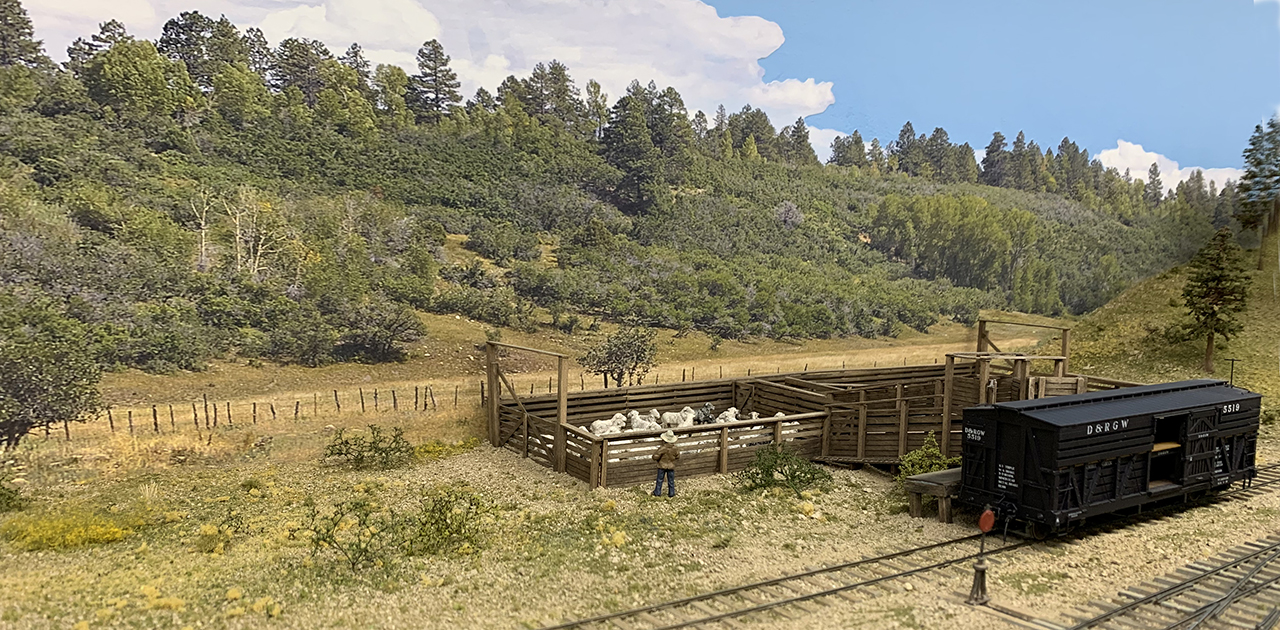
One more example of Dale’s excellent blending of backdrop and foreground, the sheep pen at Hesperus. I’m not sure I have ever seen better backdrop incorporation.
This was a great weekend of operation, four outstanding layouts and a great deal of fun and fellowship. I couldn’t have asked for anything more. My heartfelt thanks to the organizers and all the layout owners. Well done.

Tony Thompson
Sunday, March 27, 2022

More on empties

I posted a discussion last month about the model railroading operation-cycle problem of confiscating empty cars, when a system of paired paperwork for loads and empties is in use. I included some ideas about how to “break” that empty-load cycle if already in existence. That post can be found here: https://modelingthesp.blogspot.com/2022/02/waybills-part-94-handling-confiscation.html . 

In the present post, I want to say a little more about empty cars in model layout operation, specifically the issue of car flow. As with that previous post, the issue arises if one has in use a car-card or waybill system that matches loaded and empty paperwork in one packet. 

Though that arrangement is convenient, and effective in moving a car to and from staging, one has to face the issue of car flow. How often does such a car movement cycle happen at each industry? This is the essence of car flow.

I have written several previous blog posts about car flow. One was a general one (which you can find at this link: https://modelingthesp.blogspot.com/2016/09/car-flow-for-operating-session.html ). Way back in 2011, I also wrote a more detailed account of a method I have used to formalize how car flow works (here’s a link to the second of the two posts about that topic: https://modelingthesp.blogspot.com/2011/11/operations-demand-based-car-flow-2.html ). 

The key point is to ensure that industries that receive empty cars for loading get a regular supply of them (and what “regular” means will vary from industry to industry). This is effectively the reverse of the familiar situation in which a load is delivered to an industry, and later the empty car is picked up and sent on its way.

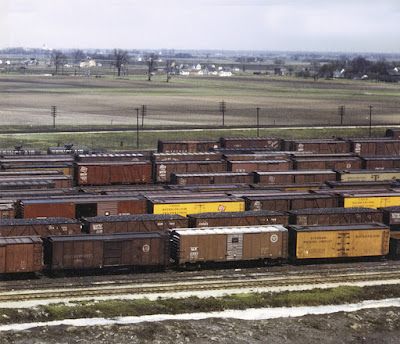
Of course most of our model freight cars are not obviously empty, any more than are most prototype cars. I can make that point with this often-published 1943 photo from the Library of Congress, showing a Milwaukee Road yard in the Chicago area (I believe Bensenville). You can see two empty gondolas, several gondolas loaded with coal, and at least two box cars with doors ajar, thus likely empty. None of the rest of the cars give you any clue as to whether they are loaded or not. But our model paperwork can indeed tell us which cars are which.

The essential point to be made here is that any operating scheme for a layout has to manage the flow of empty cars as well as loads. On my layout nowadays, the primary tool is the Actions list, as I described in a post awhile back (see it at: https://modelingthesp.blogspot.com/2019/07/waybills-part-66-car-movement-system.html ). This list, an example of which is shown in that post, identifies all “actions” (car movements) in a session. But more important in the present context, a set of successive lists provides a record of previous sessions. 

With that in hand, and any kind of overall operating plan for car flow (for example the system described in the post already cited: https://modelingthesp.blogspot.com/2011/11/operations-demand-based-car-flow-2.html ), the layout owner can managed the car flow to the degree desired, and always has a reference point for any future session.

One situation I have long tried to deal with effectively is the industry that doesn’t ship very often, and thus doesn’t often get empty cars to load. Here’s an example, as Alco switcher SP 1389 in East Shumala is spotting a T&NO box car at C.J. Riley & Sons for loading. As the season is spring, the cargo is likely wool. But this small warehouse company doesn’t ship much by rail, so this is far from an event of every session.

As I asccumulate more and more operating sessions on my layout, issues like this continue to pose interesting challenges, in planning how to manage car flow. Of course, most visiting operators aren’t aware of this, because few of my operators even come to every session, and sessions are spaced out in time. But I know the patterns, and I want them to be realistic ones. That’s my purpose in worrying about car flow from session to session.

Tony Thompson

Thursday, March 24, 2022

Evaluating the car fleet anew: Gondolas

 Perhaps as many as 30 years ago, I began to try to rationally plan my fleet of freight cars for the layout. I did this by analyzing the cars of each type that I had (say, stock cars), and then determining what traffic they might be needed to carry, to and from what points, and how often. The latter aspects provided an idea of how many cars of that particular type I might need, and which ones.

There was a hiatus in layout activity following my move from Pittsburgh, PA to California, because I didn’t have suitable home layout space. But in 2005 we moved to a house with a fine space, though not overly large, and layout work resumed. I have written a bunch of blog posts about the rebuilding (“rebuilding layout” should be a good search term in the search box at right, if you’re interested), but one post that captures the transition activities is this one: https://modelingthesp.blogspot.com/2018/03/how-old-is-my-layout.html .

Once rebuilding was well underway, and I was beginning to actually do some switching on the layout, I re-opened the idea of analyzing the car fleet composition. The new layout would have different features and somewhat different goals, so the fleet would necessarily differ. In addition, many new (and much better) HO scale freight cars were coming on the market, so older cars could be replaced.

I found the old computer files of my fleet planning lists, and set about revising them. Several of the revisions led to blog posts in 2011 and 2012. One of the car fleet areas I summarized was gondolas (see the post about it here: https://modelingthesp.blogspot.com/2011/04/choosing-model-car-fleet-8-gondolas.html ). I recently realized that I needed to re-visit this car type.

The traffic analysis in the blog post just cited is fine, and I wouldn’t alter the thrust of it at all. But my emphasis today is a little different. I have begun to use more General Service (GS) gondolas in ballast service, taking advantage of building some more Red Caboose kits and acquiring some Challenger brass models. Now I can run divisional ballast trains like the one below (this was also discussed in my recent Model Railroad Hobbyist or MRH article, see https://modelingthesp.blogspot.com/2022/03/my-column-in-new-model-railroad.html ), seen here passing Shumala.

Of course these cars are not limited to ballast loads. One load needed regularly at Shumala on my layout is sand for the new sand house (construction described in an MRH article in the January 2021 issue ). Below you see one of my venerable Ulrich cast white-metal gondolas (produced in the 1950s), being switched to the sand house. They are a little oversize, but are prototypically correct in their details.

Turning away from GS gondolas, tight-bottom or GB gondola are also important, and nearly all the foreign-road gondolas in my fleet are GB types, along with representative Southern Pacific GB types. One of the great things about model gondolas, of course, is the interesting loads that can be carried in them. I show below just one of my own examples, a steel beam long enough that both drop ends needed to be lowered. It’s seen here at the end of a passing train on the Coast Division main line.

The model shown here, PRR 439197, Class G26, is a 65-foot car modified from an E&B Valley kit to match the Pennsylvania Railroad prototype. The large girder is made from Atlas bridge parts.

Another important aspect of car choice is to recognize the railroads that had substantial rosters of GB cars and thus would have some likelihood of showing up on my California layout (referencing, of course, the Gilbert-Nelson hypothesis — for more info, use that term in the search box at top right). 

A major example, in addition to the PRR and the Pennsy car shown above, would be New York Central and its subsidiaries, such as Pittsburgh and Lake Erie. Below I show a load of steel beams, on the way to a team track on my branch line, spotted here at Shumala en route to its destination.

Here the model, P&LE 40205, is from a Proto2000 kit, and the load is simply Evergreen beams. One of the nice things about these kits is the interior detail, rare on commercial gondola models until recent years.

I continue to refine my gondola fleet, occasionally selling off or adding a car, but for the most part, my fleet matches my updated goals for this car type, so this part of the fleet management job is substantially complete.

Tony Thompson


Monday, March 21, 2022

Getting the car you want

 As you can likely guess, I am of course referring to model railroad freight cars. Occasionally one sees a need for something that isn’t quite available. This may call for scratchbuilding or kitbashing in many cases, but in response to several previous requests from readers, I am going to illustrate a simple example. 

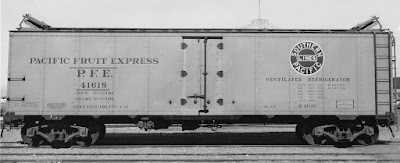
In 1936, Pacific Fruit Express was ready to build its first all-steel refrigerator cars. The design process had begun at least as early as 1932, since some of the parts drawings for these cars are dated that early. And PFE definitely needed new cars, with a long gap since the previous new ones, and still a lot of pre-World War I cars on the roster.

As Earl Hopkins, retired Chief Mechanical Officer of PFE told me in an interview, PFE had intended to buy 5000 cars, an order that would have been second only to the 6000-car order when PFE began in 1906. But prices had crept up, and the money authorized for these cars  by UP and SP wasn’t enough for the full 5000. PFE had to settle for 4700 cars, car numbers of which began a new 40,000-series. They were numbered 40001–44700, Class R-40-10.

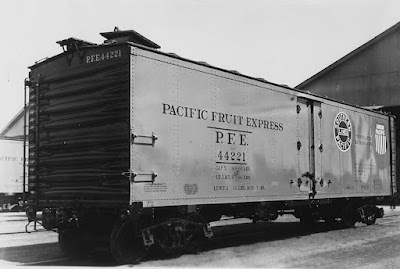
Here is a photo of the original paint scheme on these cars, a Wilbur C. Whittaker photo on the Embarcadero at San Francisco on July 2, 1941. Note the low angle of the open hatch covers, open as far as the latches permit, and the hatch plugs underneath. The car is relatively clean, though five years old; this was in the era when PFE washed cars regularly.

(This history and more, as many of you know, can be found in the book, Pacific Fruit Express, 2nd edition, Thompson, Church and Jones, Signature Press, 2000. Chapter 8 is about PFE’s steel ice cars.)

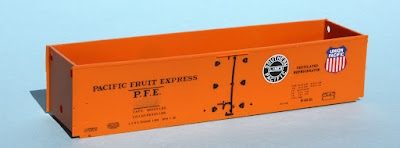
InterMountain Railway Co. has produced an excellent HO scale model of these R-40-10 cars, and I already have several of them in my fleet.  Looking at my fleet balance, I could use one more car of this class, and I had a goal as to car number. But first, let me comment on paint and lettering.

In the 1940s, PFE standards for car painting called for repainting wood-sheathed cars every 4 to 8 years, and steel cars every 8 to 10 years. By 1946, when PFE adopted a new paint scheme with both railroad emblems on both sides of the car, the R-40-10 cars would have been due for repainting. Accordingly I wanted to model a later paint scheme on my car. Here is an an example of an R-40-10 car, freshly repainted into the 1946 paint scheme, shown at Roseville in the summer of 1946 (PFE photo). These hatches are also partly open, and the car still has the original wood running board.

I have a few InterMountain R-40-10 kits in my stash. Most of the cars produced are in the 42,000-series within the R-40-10 number group. I have renumbered several of my models to get outside that subset of the car numbers. But one I don’t have is an example of the last 700 cars, 44001–44700. I decided to renumber one of the 42,000-series kits accordingly.

I simply painted out the kit car number, using Star Brand STR-27, “S.P. / P.F.E. Daylight Orange” (the correct PFE orange). The remaining lettering is fine.

With this in hand, I can proceed to kit assembly, with most of it straightforward and not calling for any description here. But two issues do need addressing: trucks and hand brakes. The specialties on large PFE car orders were usually distributed among different suppliers, so if one wishes to assemble an accurate model, these parts have to correspond to the car number.

Luckily, these specialties are called out in some detail in the PFE book (cited above), in the table on pages 434 and 435.  I will return to this research and these modeling issues in a future post, as building of the kit progresses.

Tony Thompson

Friday, March 18, 2022

My column in the new Model Railroad Hobbyist issue

 Once again, my roughly semi-annual column in the “Getting Real” series (several columnists alternating) appears in the new issue of Model Railroad Hobbyist. This time, my topic was “Crew Communications,” and it is included in the “Running Extra” part of the March 2022 MRH. (That part of MRH can be purchased as a single issue, or they are much cheaper per issue if you subscribe). Get the details from their website, www.mrhmag.com .

What I covered in this article was the communication that train crews would have had (in most cases) in the pre-computer era of railroading. By that I meant waybills, switch lists (if any), agent messages, management bulletins, and line-ups. Each of those topics has been covered in various of my blog posts, but this article brings all the material together, and doesn’t directly duplicate any of the posts. 

The article described the work that railroad personnel did with waybills, though not describing model waybills per se, as that topic has been covered in other articles. Of course, the waybill enables a switch crew to know which cars to switch, and what to do with them. Here’s an example from my layout town of Santa Rosalia, a loaded PFE reefer at Coastal Citrus, ready to be picked, en route to Albany, New York.

I gave links in the article to the various blog posts which can be regarded as background on specific topics such as Car Distributors, Car Service Rules, bill boxes, agent messages, line-ups, and timetables. The MRH presentation touches on these topics in less detail than what is in the blog posts, in an effort to give a “big picture” overview of how these kinds of communications can be modeled.

I included a number of photos in the article, showing prototype railroad employees doing their jobs, from agents to switchmen to conductors. Here is one of them, an interesting 1952 photo at SP’s Alameda Street Yard in Los Angeles. The switch foreman (left) and a switchman are deciding on the blocking of a freight train. The foreman holds some waybills, folded the long way, and the switchman is writing something, likely a switch list. Most employee photos in this era show men in fedoras.  (Richard Steinheimer, DeGolyer Library)

All these communication methods really reflect the various jobs people did switching on the railroad, which are the job experiences I want to try and reproduce in model form in my operating sessions.

It was an interesting process to pull this article together, as it touched on the whole range of prototype communications that I have researched over the years, so that I could provide them in model form to switch crews in my layout operating sessions. I have enjoyed learning about these topics, and have equally enjoyed figuring out how to represent them in model form, and then of course seeing them in use, helping my layout come alive in operating sessions.

Tony Thompson

Tuesday, March 15, 2022

At last! Post-pandemic operating!

 I have really been looking forward to actually feeling like the pandemic is fading behind us (knock on wood), and returning to operating sessions on my layout. It seems like the time has come, so I invited a bunch of the usual suspects for the weekend days of March 12 and 13 (last weekend), reminding those coming on the 13th to please remember Daylight Saving time (!). 

You have likely already heard about this because of my previous “getting ready” post, entitled the “Long Snooze,” which is accessible at this link: https://modelingthesp.blogspot.com/2022/03/the-long-snooze.html . As I said there, I did have some maintenance issues to deal with, and as it happened, all of the fixes held up in the session. The only major in-session problem was failure of an ancient Caboose Industries ground throw, which will be easily replaced. 

The first day, I operated with the usual locomotives that I have  been using, a diesel switcher at Shumala and one of my several Southern Pacific Consolidations for the local. As is usual, each two-person crew begins on one side of the layout and, after completing the first round of work there, trades with the other crew so both get to work both sides of the layout, involving different work. At Shumala, it’s essentially yard switching, while at Ballard, it’s the Santa Rosalia Local doing road work.

The first day, I happened to get the best photographs of both crews at Ballard. Below, you see Chuck Hakkarinen (left) and Ed Merrin, working with Chuck as the conductor on the local. Chuck has several waybills in his hand. Ed was the engineer in this segment, and they switched jobs when they moved over to Shumala.

Later, after the two crews traded, I captured Jon Schmidt (at left) and John Sutkus doing their turn with the local at Ballard. In this view, Jon was the conductor (they also had traded jobs between the two sides of the layout).

The following day, we naturally had two new crews, but more importantly, Mark Schutzer brought two of his Southern Pacific steam locomotives, very fitting choices for my 1953 SP layout. One was SP 2799, a Consolidation. The other was SP 1284, an 0-6-0 of distinctive SP appearance. I don’t own a steam switcher myself, so this was the very first time Shumala had been switched with steam.

Mark provided me a good photo of the Consolidation, shown below. As you can see, it has an inherited tender from an early cab-forward, a very large tender, thus dramatic. This was common in later years with smaller SP steam, replacing their original smaller tenders.

Back to the session. Below are Richard Brennan (at left, conducting), and engineer Jim Radkey, switching with the 0-6-0 (though you can’t see it very well). This was fun to watch (and hear), and the crew operating this switcher really enjoyed it. This definitely makes me think about acquiring a switcher like this myself!

Meanwhile,  Mark (at left) and Pat LaTorres were working at Ballard, with Mark acting as conductor at this point. Both crews worked efficiently and not only got all the work done in good time, but made very few errors. Nice to see experienced and effective operators at work.

Referring back to my “getting ready” post (link in the second paragraph of the present post), this pair of sessions seemed like considerably more work than the usual preparation, only because so much accumulated waybill and car spot disorder had to be removed, and of course track and wheels cleaned as they had not been for some months. But it paid off in a relatively fault-free pair of sessions.

In making assessments like this, I am always mindful of the description by Paul Weiss of what he termed “Host Flaw Hysteria,” in which even the most minor difficulty is perceived by the host as towering above the many aspects of the layout which do work and work well. The visiting operator naturally sees it the other way around. Or so I hope.

Tony Thompson

Saturday, March 12, 2022

The long snooze

 Like most modelers during the pandemic of the last two years, I have had a relatively inactive layout. At least I did have a few operating sessions with my granddaughter (see for example: https://modelingthesp.blogspot.com/2021/12/more-family-ops.html ). But these did not exercise the layout very extensively, as they were all “reduced-length” sessions. At least some wheels turned — but still, much of the layout has had a long snooze.

An obvious point is cleaning. All track, every bit, including staging, needed to be cleaned, and wheels of locomotives needed cleaning also. I also checked track gauge in places where there have been issues in the past. Yes, track can shift with time, as I have certainly learned.

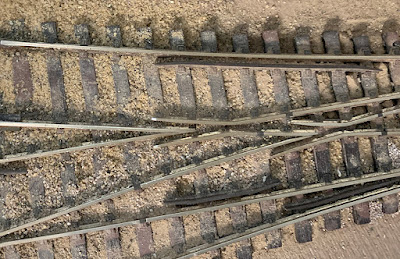
In addition, I now know to check the gauge of all my Peco switches. I have seven of them on the layout, and all operate perfectly — except for track gauge on two of them (for a report: https://modelingthesp.blogspot.com/2018/07/trackwwork-wars-part-2.html ). Once again one of them is acting up by apparently shrinking the plastic parts, because where the track gauge used to be fine, now it is tight. This is through one part of a 3-way switch.

The problem area is the diverging route at the top of this photo, just as it clears the frog area. I have simply had to file the rail head here to get it into gauge. The Peco people claim they have “never heard”of such a problem, but having observed it with more than one of their switches, I regard their denial with some scorn.

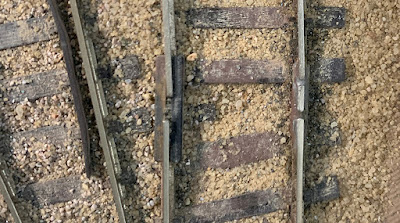
At another switch, I found a gauge problem also, as you can pretty clearly see below at photo center. Here the rails are no longer aligned, for what reason I cannot imagine. But by spreading the tight-gauge part (upper rail) slightly, I was able to correct this.

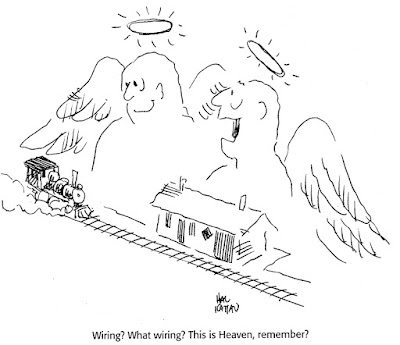
In addition, of course, there were electrical issues. Long-time readers of this blog will recall a number of installments of my series, “Electrical Wars” (you can use that term in the search box at the top right of this post, to find examples). And there were a few that had arisen during the snooze.

I recently was sent the cartoon below, which expresses my own feelings quite well. It’s by Hal Kattau, who did cartoons for Model Railroader for years, but I can’t find that this one appeared there, going through my CD archive of the magazine. My source couldn’t remember where he got it, so my apologies for not citing the source.

Next I had to address the “population” of freight cars on the layout. Normally, these cycle from operating session to session, and move through the normal steps: arrival on the branch, spotting at destination, and later being picked up to move off the layout in turn. But during the snooze, many cars were arbitrarily added or removed, mostly added, so this all had to be thinned out.

In addition, waybills were entirely out of order. Many remained from much earlier sessions; a fair number of cars that were on the layout had no waybills present; and so on. I simply had to make all of that rational with an intensive waybill re-think and re-work, to set up the upcoming session.

It was nice that the result was a “lean” layout appearance, no more excess cars everywhere, and ready for this weekend’s operating session. And right now, everything seems to be working (until the dreaded “guests present” glitches occur).

Tony Thompson