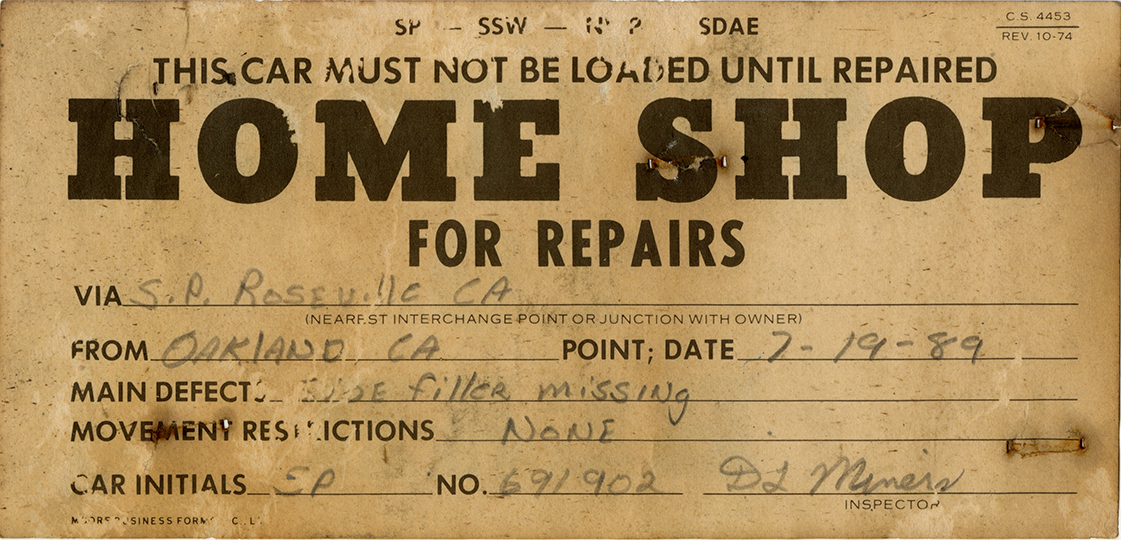
Showing posts sorted by relevance for query empty car card. Sort by date Show all posts

Thursday, June 2, 2011

Waybills, Part 8

I realized in discussing the way I manage my waybill operations that I haven’t made clear the handling of empty cars. As mentioned earlier, the prototype used a form which was as tall as a regular waybill but only half as wide (to accommodate the common practice of folding waybills in half the long way), and these were used to move empty cars.  This form was usually called an Empty Car Bill or something along those lines.
     Here’s an example of one such document, from the Erie:

As with waybills and other prototype forms, there is more information allowed for in the form than we generally need in model forms. So as with other waybill-related forms, I’ve made a simplified model form. There is more information about the use of these in a model waybill system in my two published articles:

“Prototypical Waybills for Car Card Operation,” Railroad Model Craftsman, December 2009, pp. 71–77.
“Contents of a Waybill,” The Dispatcher’s Office (publication of Operations SIG), April 2010, pp. 17–24. (A corrected version of this article was presented in a prior post, at: http://modelingthesp.blogspot.com/2011/01/waybills-2.html.)

     Before showing my current model forms, it should be emphasized that these prototype forms differed from waybills in that they only were valid on the road which issued them. Upon reaching a junction with another railroad, the receiving railroad might choose to confiscate the car for use on that railroad, or could send it empty to its owner if there was a direct connection, or send it further along the reverse service route. But whatever the routing, it would have to be identified on a new Empty Car Bill issued by the road on which the car was now located.
     On a particular railroad, it might be known that cars of a certain type, let’s say flat cars, were needed for loading at another point on the same railroad, in other words, that the empty car might be confiscated. In that case, the Empty Car Bill would not direct the car to the junction from which it was received loaded, but would be directed to the loading point which needed flat cars.
     As can be noted on the Erie prototype form shown above, the same form can be used to route cars homeward (Home Route Card) or to move empties in any other way needed (the Empty Car Waybill). I’ve retained that distinction on my model Empty Car Bills. And although I originally intended to identify car type (box, flat, etc.) on the Empty Car Bill, it really isn’t needed with my design of car sleeves, because the car type is on the sleeve. I’ll illustrate.
     Here is an Empty Car Bill, in a car sleeve, with the sleeve showing the AAR class identification. It is clearly a box car made empty at Shumala and now to be moved to the next major terminal northward (SP westward), Oakland.


This kind of Bill permits movement in either the logical direction homeward, or in a direction specified by an “Equipment Instructions” document (the latter was explained, and an example given, in a previous post on freight traffic, at:  http://modelingthesp.blogspot.com/2011/01/modeling-freight-traffic-coast-line_30.html).
     Inbound empty cars are ordinarily directed to the destination agent, not to a specific industry. When the switch crew arrives at that town, the agent will tell them where the car goes, or if the agent is not on duty when they arrive, there will be a message waiting for them in the “bill box” on the outside of the depot or freight station. However, a shipper request does result in a particular car type being needed, so my inbound Empty Car Bills “For Loading” have that AAR designation in the upper part of the form, and of course the selected car has to match that designation:


A stock of the ones without AAR designation are kept at each town to facilitate movement of empty cars after unloading. Bills for inbound empties for loading, however, are managed as part of the same waybill system as inbound loads. So far this approach, using two types of Empty Car Bills, has been working well for handling empty cars on my layout.
Tony Thompson

Wednesday, September 21, 2022

Waybills, Part 99.1: response to comment

 This post is an update to the previous post with this number (99), to respond to thought-provoking comments by John Barry. I felt it might be better to give them some space for elaboration, rather than make a short response in the comments to Part 99. (You can read that post at this link: https://modelingthesp.blogspot.com/2022/09/waybills-part-99-more-on-overlay-bills.html )

Let me begin by show again John’s comments, divided into two parts. Here is the first:

“Why bother combing through all your outbound bills? Why not generate SP bills for all of your cars with just the car info that shows above the overlay and have the remaining fields blank? Three items in the sleeve, the unique inbound full Bill, the empty car bill and behind it, the blank outbound Bill with the car info. Make all your outbound loads short bills that you can slip on top of the car specific card. File your used inbound bills by industry and car number and your outbound bills by industry only. That should minimize time on searching for a suitable waybill as you re-stage. You can also add yellow delivery overlay bills to direct empties to industries for loading.”

There are several parts to John’s comments, so I want to answer each. First, John’s suggestion that all cars have a SP “blank” waybill: he is right that this would work. But in effect, doing this wastes one bill. I did start to do this with my perishable bills for reefers, and realized, “why waste a bill?” Any use for another destination makes an overlay necessary, but for at least one movement, no overlay is needed. And I have used overlay Empty Car Bills from the beginning.

His suggestion, that all bills be filed by industry, is what I already do. And within each industry file, the bills are in order, first alphabetically by reporting mark, then by car number for each reporting mark. This makes bills easy to find, and in fact I do little “searching” for bills. This is because of the tool I created to list existing bills, my “pairs list,” which I’ve described in previous posts (for example: https://modelingthesp.blogspot.com/2012/02/waybills-17-pairs-list.html ).

It is quick and easy to look up any car number in the pairs list (so named because it shows pairs of industries, the shipper and the consignee), pull the corresponding bill, and add overlays if needed. 

My storage system uses a storage box produced by one of the companies that makes storage materials for baseball trading cards (the clear plastic sleeves I use for waybills were intended for those trading cards). I described that in a previous post (see it here: https://modelingthesp.blogspot.com/2017/03/waybills-part-58-more-on-managing-bills.html ). Here is what it looked like, with dividers for industries, in a photo from a few years ago (it now contains more waybills):

Let me now turn to the second part of John’s commentary:

 “After a car is spotted, if it still has its inbound Bill, the next session, it’s still unloading. If you’ve pulled the inbound Bill, the empty car card will show, and you can either send it home by simply removing the inbound Bill between sessions or send it for loading with an industry overlay. Spotted empties get their empty car card moved to the back of the sleeve when loaded and a destination overlay added. From staging, pull and store the car and store it with its sleeve of empty car and SP blank load bills, ready for a new inbound Bill.”

In an operating session, any car that will not be moved will not have a waybill visible to crews (I separately store waybills for “inactive” cars). For operators, this is prototypical: you handle the cars for which you have paperwork. The railroad was in some ways just like the military: nothing happens without paperwork.

I don’t remove the bill with the inbound load for a car that is spotted: it is just slipped behind the yellow Empty Car Bill that is also in the sleeve. That yellow bill returns the empty (commonly)  to Los Angeles, or other destination. 

Here’s an inbound load, and an Empty Car Bill to return the car when empty, both in the sleeve. This particular Empty Car Bill moves the car homeward via the reverse route (see the inbound waybill; you can click on the image to enlarge it if you wish).

For the opposite kind of sequence, in which an empty car is spotted for loading, then later picked up with an outbound load, the process is reversed. That is, the car arrives with its inbound yellow bill in the sleeve, then the outbound bill in the sleeve behind the yellow bill simply comes to the front. Both items in the sleeve can be overlaid with a partial or overlay bill of the correct type.

To summarize, John suggests a series of waybill actions that are the same as what I do, with one major exception: I don’t have, and don’t plan to have, a bunch of “blank” SP waybills. As I said, I don’t see any point to “wasting” a blank bill. Why not have one of the destinations for that industry be on a bill? If it’s a common destination, I can also make a duplicate as an overlay so that other cars can do the same. 

Thanks again to John Barry for carefully thinking through the waybill process, and making interesting suggestions about how it can be managed. I have enjoyed thinking through this process anew, and I hope my responses and explanations are clear.

Tony Thompson


Friday, June 12, 2026

Route cards, Part 35: still more examples

This is another post in a series about route cards, the small tags of light cardstock, typically about 3 x 5 inches, attached to freight cars to inform switchmen how to switch a car. They were attached to small tack boards, which after 1937 were 5.5 x 9 inches in size (documented in a previous post: https://modelingthesp.blogspot.com/2011/12/route-cards-6.html ).

 I’ve previously also shown prototype examples of these cards, along with ways to model them, and photographs of them on prototype route card boards. I’ve also shown photos of yard clerks applying these cards (see, for example: https://modelingthesp.blogspot.com/2023/07/route-cards-part-18-further-examples.html ). In this post, I want to to show more prototype examples of cards, once again drawn from the Michael Litant collection.

My first example is a classic transfer card, identifying a car to be exchanged to another railroad. In this case, it’s a Missouri Pacific card for interchange to the New York Central, most likely at St. Louis, car destination Worcester, Mass. I can’t read the contents, but the car is SP 123857, a 40-foot steel box car with a 6-foot door. This card is 3 x 5 inches.

A second card that I find interesting is this Cotton Belt card, identifying an empty car to go into Train 15 leaving East St. Louis. The car itself is not identified, presumably because  switchmen only needed to know that the car was assigned to Train 15. The card is 3.5 x 3.5 inches.

The third card in this post is a really interesting one, possibly filled out by the shipper. It’s a Northern Pacific card, and identifies Illinois Central 43473, a 50-foot double-door box car, to be exchanged to the Rock Island, and further routing is then Kansas City Southern and Louisiana & Arkansas to New Orleans. The shipper is identified as the Industrial Crating Co., and what they crated were tractors from Minneapolis-Moline, Inc. (though by the 1964 date on the card, White Motor Co. had taken over M-M). The crates are destined to Anthony Gibbs & Co,, care of W.R. Zanes at 223 Tchoupitoulas St., New Orleans. This is practically a waybill. It’s 4 x 6 inches.

The next car I will show is a Union Pacific card, clearly for transfer to the Milwaukee Road. The car is UP 166458, a 50-foot steel box car with cushioned underframe and combination doors, one sliding and one a plug door. The consignee, “BB Pr 30,” is not decipherable, though a friend offered that it might be Pier 30 somewhere. The shipper is shown as “YD” or yard, obviously meaning coming from an inbound train to whatever yard it was.  It is 3.5 x 2.75 inches in size. 

My fifth example in this group is a Santa Fe switch card, containing minimal information, but of interest for its format, unlike most route cards I have seen. It does identify the car to which it was attached, KCS 25772, a 50-foot box car with a single 9-foot door. The card is 4 x 4 inches.

Lastly, I will show an interesting card from the Kentucky & Indiana Terminal Railroad, operators of a bridge across the Ohio River near Louisville. They had a yard on the Kentucky side, which is where this card was issued, for a car destined to the Louisville & Nashville. The car’s initial is only shown as “B,” likely B&O, a user of the bridge; if so, this car, number 299138, was a 50-foot steel car with a single 8-foot door and equipped with Evans 18-belt DF loaders. The cargo appears to be rope. This card is 4 x 3 inches.

As I always comment, to me these surviving cards (out of the many millions that were once used) portray railroading in another time, and more importantly, in ways we can learn from.

Tony Thompson

Friday, April 13, 2012

Waybills, Part 22: handling empties

Over the past year, I have received several emails about handling empties in a prototype manner. The most recent and most specific questions were from Bob Sterner, who writes a fine Soo Line blog of his own (for example, at: https://sites.google.com/a/bobsworkbench.com/bobsworkbench/operations/layout-waybills ). So I thought I might be useful to say a little more about the subject. I don’t think I have left anything out in prior posts, but evidently I didn’t manage to describe things very clearly.
     Sometimes a questioner asks about the connection to the Car Service Rules, which I’ve discussed in two prior posts (these can be viewed at: http://modelingthesp.blogspot.com/2012/01/car-service-rules.html and also at http://modelingthesp.blogspot.com/2012/01/car-service-rules-2.html ). Surveys in the 1950s found that the Car Service Rules were being obeyed in about two-thirds of all cases, so they are certainly not something a modeler has to rigorously observe (you would be outdoing the prototype!). But the rules do not say much about empty cars. You can find these rules in the back of any Official Railway Equipment Register since at least the 1930s.
     By the way, if you would like to know more about those rules, you will probably enjoy the fine book by E.W. Coughlin of the AAR, entitled Freight Car Distribution and Car Handling in the United States (AAR, 1956). He explains the rules in some detail, and describes many of their implications. As I said, these rules are mostly for the selection of cars to be loaded (although Rule 2 provides that empty foreign cars at a junction with the owning road should be delivered directly to that road, regardless of prior service route).
     But let me clarify empty handling. If you have a foreign empty in your yard, don’t need an empty to load, and want it off your rails to avoid per diem, there is only one place (assuming your yard is not an interchange with the owner of that car) that an interchange railroad would accept it: the junction where they gave it to you in the first place. Try to hand it off to any other road or any other junction and the receiving road had the right to refuse it. So reverse routing wasn’t just a possibility, it was enforceable, and you can see why: no one wanted to pay for moving an empty which they hadn’t benefited by when it was loaded. Freight mileage was only billed on loaded cars.
     Interchange points maintained huge books called “jumbos” (I have a monthly one from Bieber, California, where GN and WP met) and kept track of all cars passing through in both directions. That was one way you knew if you wanted to refuse a car or not.
     Another method used by some railroads was the Home Route Card (sometimes combined as part of the Empty Car Bill). I showed an Erie Railroad example, which is simple in its Home Route portion, in an earlier post (see: http://modelingthesp.blogspot.com/2011/06/waybills-8.html ). Here is an example of another railroad’s version of this form, to show a much more complex approach to the Home Route information (click on it to enlarge).


     This one is the size of an Empty Car Bill and would be the size of a stack of ordinary waybills, folded the long way (about 4 x 11 inches). It would be attached to the waybill of a loaded car, in principle, and would get filled out as that car moved to its destination. Then all the junction information would be handy for returning the empty. The idea of the home route card was to provide a simple record with the car of routing information, so it was easy to direct the car homeward. But these tended to get lost or damaged, or incompletely filled out (Coughlin discusses this), so not every road used them, or used them consistently.
     When the empty was successfully transferred to another road via its service route, it then might be chosen by the receiving road to be loaded, or it might be moved further along the reverse route to the next railroad in the chain, and so on.
     As modelers, I think use of either an Empty Car Bill or a Home Route/Empty Car Bill (reduced appropriately to convenient model size) does confer some realism in handling empties. They should of course be directed to the interchange from which they came to reach your layout, so the Empty Car Bill which you make for the car (or to balance a loaded move) needs to have been created along with the waybill, so the two will match.
      A further point for those modeling interchanges is that the famous “midnight shove,” to get as many cars as possible off of your railroad and onto someone else’s railroad, and thereby avoid paying tomorrow’s per diem on the cars, is only realistic if the empties in question came from that interchange as loads. Otherwise, as noted, the receiving railroad can refuse them. In other words, the “midnight shove” did not simply clear out all empties in the yard and dump them on an interchange track, though I have seen layout operations in which that was done. The exception, of course, would be a short line’s yard which is that road’s sole connection to the outside world, making it necessarily the interchange at which all cars are received.
     These considerations for prototypical handling of empty cars, though perhaps less interesting than handling loaded cars, are nevertheless part of realistic and prototypical operations. They aren’t hard to implement, and if you are not already doing so, I recommend you give it a try.
Tony Thompson

Friday, July 26, 2019

Waybills, Part 66: car movement system

In my previous post, Part 65, I wrote about what model waybills do in a layout operating session, and of course the main purpose is to direct car movements, loaded and empty, as the operating plan directs. This can be accomplished with a wide variety of waybill types, including stunningly unprototypical ones, but all of them can work. That post, should you wish to read it, is here: https://modelingthesp.blogspot.com/2019/07/waybills-part-65-why-fuss.html .
     In a comment to that post, Jeff Aley made some additional points. With Jeff’s permission, I want to develop those, because they are important in model railroad operation. Here is his first point:

     “I think there's one additional objective for the CC&WB. In systems
     where a Car Card is mated to a Waybill, the system serves as a means
     to track shipper's demands for cars, and the subsequent delivery
     of loaded cars to consignees.”

This is quite true, and any system for car movement on a layout needs to do exactly what Jeff describes. It need not be a car card-waybill combination (what Jeff refers to a CC&WB), but can be any of several systems.
     For my layout operating sessions, I create an “Actions” list for all industries, though some of them will have no cars at them, and others will have cars at them that don’t move. The point is that I know what is going to happen at every one of them. Here is just the Shumala part of such a list. (You can click on the image to enlarge it.)


Note that I contemplate two cycles of work, though only the first one is shown above, and for each cycle, I list what the starting point will be, and what action takes place in each cycle.
      This kind of planning is one way to address car movement cycles. The general problem of car cycles, that is, the patterns of car movement over a series of operating sessions, is a real one. It isn’t solved directly by waybills, nor directly by any CC&WB system, though of course something like a four-cycle waybill does direct four cycles (and why stop at four?). There has to also be a tracking process, unless you stack multiples of four-cycle bills into a car-card holder.
     I keep track of what cars go to what industries with what I call a “pairs list.” This is just a list of all industries and the waybills which exist for cars going to or coming from that industry. I’ve described the construction and use of such lists in a couple of posts. The first of these posts is a topic introduction, and it is here: https://modelingthesp.blogspot.com/2012/02/waybills-17-pairs-list.html . I have followed that up in several places, perhaps most usefully in this one: https://modelingthesp.blogspot.com/2017/03/waybills-part-58-more-on-managing-bills.html .
     Jeff also made a second point, related to the first. Here is his statement:

     “The system may also implement the home routing of empties.”

Here of course we recognize that both prototypical model waybills, and most CC&WB systems, readily accept an additional Empty Car Bill in a sleeve, or empty cycles on the four-cycle bill. The question, though, may be routing, and this is what I think Jeff means. If you model a railroad in the center of the United States, homeward empties may go in all directions, and you need a way to correctly move them, assuming of course that you wish to follow the Car Service Rules in most cases.
     There are a number of versions of Empty Car Bills out there, as I have identified in several posts (you can use the Search Box at upper right of this post to search using “Empty Car Bill” as the search term). Hopefully most people want to do better than something like this, where one simply removes the waybill:


     As Jeff pointed out, the drawback to switchlist systems is that you don’t immediately know where a car should go for the next operating session. On my layout, it isn’t an issue since most outbound cars return to storage (I have way too many cars for my layout, which has the good point that there is lots of variety among operating sessions, but obviously the drawback of repeated car handling.) But in any case, I dislike the idea that we program long series of car movements. I generally only program two: loaded and empty.
     On Otis McGee’s layout, partly on account of the complications of dividing northward (railroad east) trains at Dunsmuir for movement over either the Siskiyou or Cascade Mountains, there need to be more waybills in a certain fraction of the car sleeves to permit variety. I described this problem and the current solution to it in one of my waybill posts (you can find it here: https://modelingthesp.blogspot.com/2012/04/waybills-21-understanding-waybill.html ). This applies to the selection of both loaded and empty paperwork, as it has to apply to either route.
     I thank Jeff Aley again for raising what I think are significant points about the use of waybill systems for layout operation. (Of course, I may not be addressing the points that Jeff actually intended to make . . . if so, I hope he will respond.) Maintaining realistic car movement in an ongoing series of operating sessions is an interesting challenge, and there are a variety of ways to approach the problem.
Tony Thompson

Sunday, October 26, 2014

Waybills Part 36: Empty car waybills

I have described prototype empty car bills in previous posts, and some of those posts are listed below. In this post I return to that topic, and also discuss modeling implementation of these bills.

The general handling of empty cars:
http://modelingthesp.blogspot.com/2011/06/waybills-8.html
http://modelingthesp.blogspot.com/2012/04/waybills-22-handling-empties.html

Empty private cars: http://modelingthesp.blogspot.com/2014/03/waybills-part-31-empty-private-cars.html

Mike White’s collection of more than 20 of my posts on waybills: http://modelingthesp.blogspot.com/2013/02/waybills-27-collected-posts.html

     It may be the case that there were a few American railroads (I don’t know about Canadian or Mexican practice here) which did not use empty car waybills. But evidence continues to emerge for more and more railroads that did use them. Below is a scan of an original manila cardstock document from the Missouri-Kansas-Texas (MKT) which is 3.5 x 9 inches in size. You can click on it to enlarge the image.


It contains two parts of interest. First, at the top is a section intended to be filled out for every foreign car which came onto MKT rails. The card would then be stapled to the waybill, for use when the car was made empty, if it did not happen to be confiscated for loading. (This is to facilitate subsequent return of the empty, if necessary, via the service route by which it arrived.)


Of perhaps equal importance, at the bottom was this admonition, which clearly describes the importance of this document. The exceptions, tank cars and some refrigerator cars, are also noted and their movement documentation listed. This sentence might be a good addition to a model Empty Car bill.


     I also obtained an Atlantic Coast Line card of the same type. It too is cardstock, of a somewhat ocher color, and is 3.5 x 8.5 inches in size. It is similar on its front face to documents I have shown in some of the earlier posts whose links are shown above.


The back face, however, is also interesting in that a summary of some of the relevant Car Service Rules are printed there. This also is certainly an option for addition to model documents of this type.


Note that at the bottom of this document back is a comment about Special Car Order (SCO) 90. For post-1953 layouts, this might be a good addition also.
     Use of these kinds of Empty Car billing documents is slowly increasing on model railroads interested in prototype operation, instead of merely having a four-cycle card with a couple of moves simply identified as “empty.” This is another of those small changes to make operation more realistic.
Tony Thompson

Friday, October 10, 2025

Waybills, Part 124: Introducing my system

At a modelers’ meeting not long ago, I was asked an interesting question, one I couldn’t readily answer without visual aids. The question was, how do I introduce my layout’s system of waybills at an operating session, to those who may know nothing about it? I do have an introduction (with visual aids) that I’ve been using for years, and perhaps it would be of interest to show what it is.

I chose a number of waybills that would illustrate the main features, and printed them out on 8.5 x 11-inch paper (the waybills I actually use are only 2.5 x 3.5 inches in size).  The photo below shows that this method yields “visual aids” that can be appreciated by a group of people. 

My first pair of waybills is intended to illustrate the overall prototype format (a vertical division between the destination and consignee on the left, and the shipper and place of origin on the right; and with cargo shown below). Car initials and number are at the top, along with AAR car type (the latter not being prototypical). Here are a pair that I show (you can click to enlarge).  

These are an inbound load at left, to be delivered to an industry on the layout, and an outbound load at right, which will be picked up at an industry on the layout and moved to the SP main line to be taken to San Luis Obispo and put into a through train.

 I then show an additional pair of waybills, which were chosen for a particular purpose, beyond illustrating the prototype locations of information. The one on the left, in particular, dates from an early operating session, and the conductor who had this waybill came to me and said, “I can’t find Carlson’s Furniture.” I quietly pointed out the additional information after the name: “HS. TRK.,” of course meaning “house track.” In other words, conductors need to read the whole waybill. The same message applies to the second one; here the vital information is “TM. TRK.,” naturally meaning “team track.”

These waybills of course contain all the information a crew needs to handle them. But this isn’t true of every bill they encounter. The Empty Car Bill, modified from an SP document, looks like this for an inbound car:

This bill shows the town to which the car is destined, but does not identify the shipper. This is because the empty car was ordered by the agent in that town, and the agent knows which shipper get the car. That in turn means the crew has to stop at the depot and consult with the agent. In the model situation, there is no one acting as agent, so an agent’s message is provided (for background, see: https://modelingthesp.blogspot.com/2015/06/operating-with-agent-messages.html ). Below is a sample, showing where PFE 40559 should be spotted.  

Next I show a perishable bill. This form was recommended by the AAR to be printed on pink stock, and the SP followed that recommendation. This also could tell the crew that they need to spot the car for  initial icing, that is, filling the ice bunkers before the car begins its journey to destination.

At this point, I show a pair of tank car bills for a privately owned tank car (in this case, General American). A private owner could request that empty cars move to the desired destination on a regular freight waybill instead of an Empty Car Bill, so that movement would be expedited, rather than wait for each successive railroad which received the empty, having to prepare an Empty Car Bill.

Lastly, I show a card that is waybill-size and requests a re-spot of a car. This was modified from a UP route card. The car initials and number are shown toward the bottom, and the places from which and to which the car is to be moved are shown.

With all this being spelled out, I have found that crews understand and use the waybill system very well. So I guess the key elements must all be there.

Tony Thompson 


Monday, September 25, 2023

Route cards, Part 25: still more grading

In a series of posts, I have been writing about both route cards, cards that direct movement of freight cars, and grading cards, those that give results of an inspection of a car interior for loading. This one continues my topic of grading cards and systems. The previous post like this can be found here: https://modelingthesp.blogspot.com/2023/09/route-cards-part-23-varieties-of.html . As before, all cards are from the collection of Michael Litant. 

For my first example, an interesting instance from the Great Northern in which specific commodities are called out for the inspector’s use. Notice that there is also a provision to identify an empty car or to reweigh it. The card, 4 inches square, is dated March 7, 1967 at Grand Forks, but lists no car.

A second example is a joint card from the C&O and B&O, colorful and attention getting. It’s 4 x 8 inches overall, but is intended to be folded with the relevant grade outermost (here, grade D), and when so folded is about 2.5 x 4 inches. In addition to the usual grades A through D, there is a grade K for either wash-out or clean-out needs, and a grade H to direct a car to its home shop for repairs. Unfortunately, no car is identified, nor a full date.

Third, I will show an interesting card, because vertical in format, from Norfolk & Western. It only allows for two grades, A and A-1. Date is October 16, 1966, and the car was NKP 18451, a 40-foot, 50-ton box car. Card size is 4 x 7.5 inches.

Fourth is a 4-inch square card from the Peoria & Pekin (Illinois) Joint Car Inspection Bureau, doubtless serving multiple railroads (at least including Rock Island, Burlington, TP&W, New York Central, M&StL, C&IM, C&NW, Pennsylvania, Illinois Central, GM&O, and of course the Peoria & Pekin Union). It is 4 inches square. One side shows grade A for high-quality cargoes including bulk starch, while the other side show other relatively high-grade commodities. No car or location is shown.

Fifth, an interesting though single-sided Union Pacific grading card, with considerable information printed on it, though no car is identified. The card shows the section for grain highlighted by crossing out the other commodities there. It is stamped for Council Bluffs, Iowa, and has hand-written on the back, “Cargill, So. Omaha,” presumably where the car was destined for loading. It is 5 x 7.25 inches in size.

For a sixth example, a Burlington card, 3.5 inches square, with the usual categories of grading by commodity, interestingly including the notation “O.K.” to indicate suitability. The car is shown as CB&Q 18207, a 40-foot steel box car, but no location.

Finally I will show is one of those interesting ones used in a switching district or terminal area, this one from Atlanta Joint Terminals. It’s 3.5 inches square, and being single-sided, can only identify “grade A” cars, and the car identified appears to be B&O 478159, a 50-foot steel box car with double doors.

All these cards differ from most of the ones shown earlier in this series of posts, and continue to demonstrate the wide variety in how individual railroads chose to categorize grading and its designation on empty cars. I think all of them are nice examples.

Tony Thompson

Friday, May 22, 2026

Route cards, Part 34: additional examples

I continue to be, on the one hand, fascinated with the variety of route card appearances, and, at the same time, intrigued with all the prototype information about car movement. That’s why I’m writing this post, continuing to show interesting cards from the Michael Litant collection. You might wish to consult the previous post with some background on these cards (see it at: https://modelingthesp.blogspot.com/2026/05/route-cards-part-33-further-examples.html ).  

A classic type of route card is the “return empty” card, this one from the Long Island Railroad to the Pennsylvania. This probably would mean Sunnyside Yard, though the LIRR also connected with the Pennsy via a couple of car floats. The original card is 3 x 3 inches. 

My second example is a good instance of a transfer card, moving a car on UP rails to the CB&Q for its onward journey eastward. The car, UP 541045, was a 50-foot steel box car with a 7-foot door, equipped with Transco loaders (load dividers). Bound for Worcester, MA, the load looks like “Cake” but may be cable or a shorthand notation of some kind. This card is 4 x 5 inches.  

Another interesting card is this one, likely a Wabash on-line card designating a car to move eastward. The clerk only added the car initials, MKT, and no other information. The card is 4 x 4.5 inches. 

A fourth example is a Northern Pacific card, again a transfer card, directing SAL 19862 to be switched to the C&NW. (This was a 40-foot steel box car of 1937-AAR dimensions — 3713 cubic feet and a 6-foot door.) It gives the (rubber stamped) origin of the car as “road haul,” presumably meaning in a train arriving in whatever yard was the location of affixing this card, and the reason for movement was “shipment,” a term almost embarrassingly simplistic. The card is 4 x 6 inches. 

For my fifth card, we have yet another transfer example, evidently from the Georgia Railroad to the Atlantic Coast Line, the car being AWP 50001 (presumably Atlanta & West Point), which was a 50-foot box car with a 9-foot door, equipped with Spartan “Easy-loader” dividers with 9 belts, one of ten cars in that group. The load, syrup, was presumably in containers, thus the importance of the car having load dividers. The card is 3.5 x 3.5 inches.. 

 Finally, I’ve chosen a card showing a whiff of oncoming computerization, a Canadian National card, 3 x 6.5 inches (a little smaller than a punch card). The car listed is Northern Pacific 98472, a 50-foot RBL car, essentially an insulated box car, equipped with cross-bar loaders. 

The cargo is meat, en route to San Juan Packing in Portland, likely Portland, Maine, because of the yard office stamp for Sarnia Tunnel (the tunnel under the St. Clair River between Port Huron, Michigan and Sarnia, Ontario); this would be the original tunnel, opened in 1891). Likely the car would move eastward across southern Canada before re-entering the U.S.

These cars are, as always, interesting in themselves and in what they tell us about patterns of freight movement. Several of them could easily be adapted to model railroad layout use for operation, and the really large lettering on a few of them might show up even in HO scale.

Tony Thompson 

Sunday, March 27, 2022

More on empties

I posted a discussion last month about the model railroading operation-cycle problem of confiscating empty cars, when a system of paired paperwork for loads and empties is in use. I included some ideas about how to “break” that empty-load cycle if already in existence. That post can be found here: https://modelingthesp.blogspot.com/2022/02/waybills-part-94-handling-confiscation.html . 

In the present post, I want to say a little more about empty cars in model layout operation, specifically the issue of car flow. As with that previous post, the issue arises if one has in use a car-card or waybill system that matches loaded and empty paperwork in one packet. 

Though that arrangement is convenient, and effective in moving a car to and from staging, one has to face the issue of car flow. How often does such a car movement cycle happen at each industry? This is the essence of car flow.

I have written several previous blog posts about car flow. One was a general one (which you can find at this link: https://modelingthesp.blogspot.com/2016/09/car-flow-for-operating-session.html ). Way back in 2011, I also wrote a more detailed account of a method I have used to formalize how car flow works (here’s a link to the second of the two posts about that topic: https://modelingthesp.blogspot.com/2011/11/operations-demand-based-car-flow-2.html ). 

The key point is to ensure that industries that receive empty cars for loading get a regular supply of them (and what “regular” means will vary from industry to industry). This is effectively the reverse of the familiar situation in which a load is delivered to an industry, and later the empty car is picked up and sent on its way.

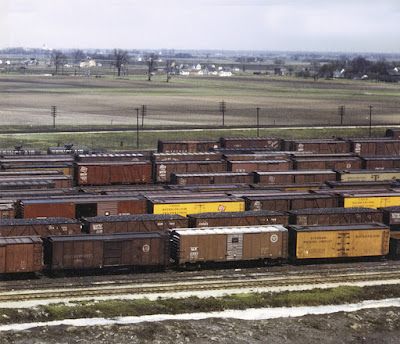
Of course most of our model freight cars are not obviously empty, any more than are most prototype cars. I can make that point with this often-published 1943 photo from the Library of Congress, showing a Milwaukee Road yard in the Chicago area (I believe Bensenville). You can see two empty gondolas, several gondolas loaded with coal, and at least two box cars with doors ajar, thus likely empty. None of the rest of the cars give you any clue as to whether they are loaded or not. But our model paperwork can indeed tell us which cars are which.

The essential point to be made here is that any operating scheme for a layout has to manage the flow of empty cars as well as loads. On my layout nowadays, the primary tool is the Actions list, as I described in a post awhile back (see it at: https://modelingthesp.blogspot.com/2019/07/waybills-part-66-car-movement-system.html ). This list, an example of which is shown in that post, identifies all “actions” (car movements) in a session. But more important in the present context, a set of successive lists provides a record of previous sessions. 

With that in hand, and any kind of overall operating plan for car flow (for example the system described in the post already cited: https://modelingthesp.blogspot.com/2011/11/operations-demand-based-car-flow-2.html ), the layout owner can managed the car flow to the degree desired, and always has a reference point for any future session.

One situation I have long tried to deal with effectively is the industry that doesn’t ship very often, and thus doesn’t often get empty cars to load. Here’s an example, as Alco switcher SP 1389 in East Shumala is spotting a T&NO box car at C.J. Riley & Sons for loading. As the season is spring, the cargo is likely wool. But this small warehouse company doesn’t ship much by rail, so this is far from an event of every session.

As I asccumulate more and more operating sessions on my layout, issues like this continue to pose interesting challenges, in planning how to manage car flow. Of course, most visiting operators aren’t aware of this, because few of my operators even come to every session, and sessions are spaced out in time. But I know the patterns, and I want them to be realistic ones. That’s my purpose in worrying about car flow from session to session.

Tony Thompson

Saturday, July 16, 2016

Route cards, Part 13 — other examples

The previous two posts in this series contain examples of the prototype route cards in the collection of Ralph Heiss. (You can read the most recent one at this link: http://modelingthesp.blogspot.com/2016/07/route-cards-part-12-more-examples.html .) Many are from the 1950s and 1960s. Most were retrieved from freight cars in service, often on route card boards which had a number of cards stapled to them. According to folks who have worked in yards, there was no reason and usually no time to remove old route cards when adding new ones; the new card would simply be stapled atop the accumulation, or alongside it.
     Before I show more cards, I want to address a question I received via email. The questioner wondered whether flat cars had route card boards, and if so, where. As with many open-top cars, a common location was near the left bolster, as you see on this SP car (between the second and third stake pockets from the left). The photo was taken April 16, 1950 at Ithaca, New York (Arnold Menke collection).


But as always, clerks did things as they liked, and with any car having wood parts, they might well staple that route card anywhere convenient. That's shown in this photo of a route card simply affixed to the end of the deck planking of the car (which is a Class F-70-2 car of the SP, in an SP photo). You can click on the photo to enlarge it.


     Returning to prototype route cards themselves, one particular type of card directs a car to be switched to interchange with another railroad. I showed a number of such cards in an earlier post (which you can peruse at this link: http://modelingthesp.blogspot.com/2013/12/route-cards-8.html ), and the Ralph Heiss collection includes more of them, too. Here I show a few of them. The one on the left is a Peoria & Pekin Union card, and is directed to the Nickel Plate (the initials “NKP” are underneath the large numeral 8; you can click to enlarge). The middle card is especially interesting, as it is round instead of rectangular; it is an Alton & Southern card directing a car to the Cotton Belt interchange. The one on the right is probably a card to move cars to an SP interchange, though no additional information can be discerned on the card itself.

     Another group of this card type is shown below. The one on the left is quite clearly an interchange card, moving a car from the Burlington to the Chicago Great Western. The one on the right is less clear, with the symbol “CRI” possibly referring to the Rock Island under its old mark of CRIP, but is probably some other symbol. It is for Great Northern car 43955 at Proviso Yard, and the destination is shown as Elmira, New York via the Erie. Thus CRI is likely an interchange symbol to the Erie. It is an unusual card in one other respect: it is dated and includes the year, Oct. 28, 1955.


     A third group of these kinds of cards is shown next. The left-most card clearly is an assignment to a “Fast Freight” though the railroad or train symbol are not shown. The center one is a Union Pacific card directing a car, UP 188952, to the Southern Pacific. The card at right directs an empty SP car home to the SP, evidently at an interchange point or directly connected to one.


     Lastly, two more interesting examples. The left-most is a Rock Island card directing car ATSF 17184 to a “Red Ball” train destined to Council Bluffs, Iowa, perhaps as symbol Q37A, or maybe that is a classification track. The round yard stamp is for Burr Oak Yard, Rock Island’s yard in Blue Island (Chicago area) which mostly made up westward trains. The card on the right, dated Feb. 11, 1956, is another Proviso Yard (Chicago) card, and the symbol “FRD” is likely a train symbol, though it could mean “forward.” The car identified is SP automobile car 64782.


     As in the previous posts in this series, the format and appearance of these route cards varies greatly from one example to the next. In O or G scale, it would be possible to try and reproduce some of these “looks,” but in HO only the fattest lettering would be discernible. I really have enjoyed examining and trying to learn from these cards, so once again, my warm thanks to Ralph Heiss for sharing them.
Tony Thompson

Monday, February 27, 2023

Home Shop forms

For decades, prototype railroads have used a paper form intended to route a damaged car to its home shop for repairs. Usually of a size to be stapled to a route card board, they were usually light card stock. I thought this might be a good form to introduce on my layout. 

(For background on route card boards, you might wish to look at this post: https://modelingthesp.blogspot.com/2011/11/chalk-marks-and-route-cards.html , with more information on the actual AAR standards for such boards described at this link: https://modelingthesp.blogspot.com/2011/12/route-cards-6.html .)

Here’s a Southern Pacific example of such a Home Shop form, well darkened by being out in the sun and weather until I rescued it from a car body with no trucks (thus probably no longer headed somewhere). The original is 3.25 x 7 inches in size.

The back of this card is interesting: it can serve to direct a car’s location in a train, for example a very light car might well be handled preferentially at the rear of the train. I will have to give some thought to whether I can use this in model form.

The card is a little damaged and quite dark in color. But of course in Photoshop all that is fixable. I lightened the background, removed the pencil writing, and repaired a few damaged areas. This gave me a starting point I could use.

Next I removed the part of the image that wouldn’t fit with my era, namely the four railroads listed at the top of the form (SP, SSW, NWP, SDAE). I then sized the image so it would fit into my waybill sleeves, which are baseball-card-collector sleeves, with a long dimension of 3.5 inches. This could now be printed out for use in an operating session.

To illustrate, here’s a yellow Empty Car Bill, overlaid with a filled-out Home Shop card. This doesn’t change how the car will be handled in my operating session, but it makes a different direction being given to the crew. The variety seems like a good feature. On some layouts, with foreign-road interchanges, or with main yards that direct empties for loading, this could change car handling. 

I filled this out in ink for visibility, but most prototype examples I have seen were filled out in pencil. I will experiment with a soft pencil to see if that can be more visible. The prototype form is over twice as big and so writing is easier to read on it.

I should mention here that I do have a prototype SP bad-order card in use on the layout, as I have described previously (you can see my post about it at: https://modelingthesp.blogspot.com/2018/04/a-new-bad-order-card.html ). But because it is “nice looking,” as one person put it, visiting operators don’t like to use it to designate cars that need work. I like the “Home Shop” card because it can be used to move cars or to indicate bad orders.

I should also show an example of a Home Shop card from another railroad, in this case Santa Fe. I found this on a car not at Stockton, as the card mentions, so either the car was continuing to be moved, or had been repaired and the card not removed. This card is 8.75 x 3.75 inches in size.
The back is quite interesting; it is a Bad Order card, so obviously a carman could use whichever side suited his needs. It calls for quite a few specific indications of why the car is bad-ordered, and is of course a rather eye-catching color (the original is more of a fluorescent orange).

I will return to the topic of ways such cards could be used in model layout operation, along with results of my own experiments, in a future post.

Tony Thompson