Thursday, November 9, 2023

Small project: an SP Boarding Bunk car

Among the interesting and, frankly, inspiring models I saw at the Southern Pacific Historical & Technical Society meet in Bakersfield at the end of October was a pair of ex-Pullman passenger cars, painted and lettered for service as maintenance-of-way bunk cars. (For more on that meeting, see my post at: https://modelingthesp.blogspot.com/2023/10/the-2023-sph-annual-meeting.html .) And for a connected series of posts on MOW modeling, see: https://modelingthesp.blogspot.com/2015/08/modeling-sp-mow-cars-part-4.html .

A little background. As the traveling public gravitated increasingly to room accommodations in sleeping cars, in place of open sections, the very numerous Pullman 12-1 cars (12 sections, 1 drawing room) began to be less needed. Many were converted to other floor plans having rooms (taking advantage of the highly modular design of Pullman heavyweights).

Many others, however, were converted to “tourist sleepers,” as they were known, cars intended for economy travel. The drawing-room toilet compartment was sealed off, and the rest of that room converted to a 13th section. Pullman then gave these cars numbers in place of their previous names.

In 1948, a number of railroads, including SP, purchased a lot of these cars for use as maintenance-of-way bunk cars, in SP’s case, 78 cars. (As MOW cars, these were numbered SPMW 4800–4877.) The majority of these 13-section cars had never been air-conditioned, and most SP cars remained that way. Over time, many were modified and cut up in a variety of ways, making them look less and less like the original Pullmans, but in 1953, my modeling year, most cars like this would still have looked quite original.

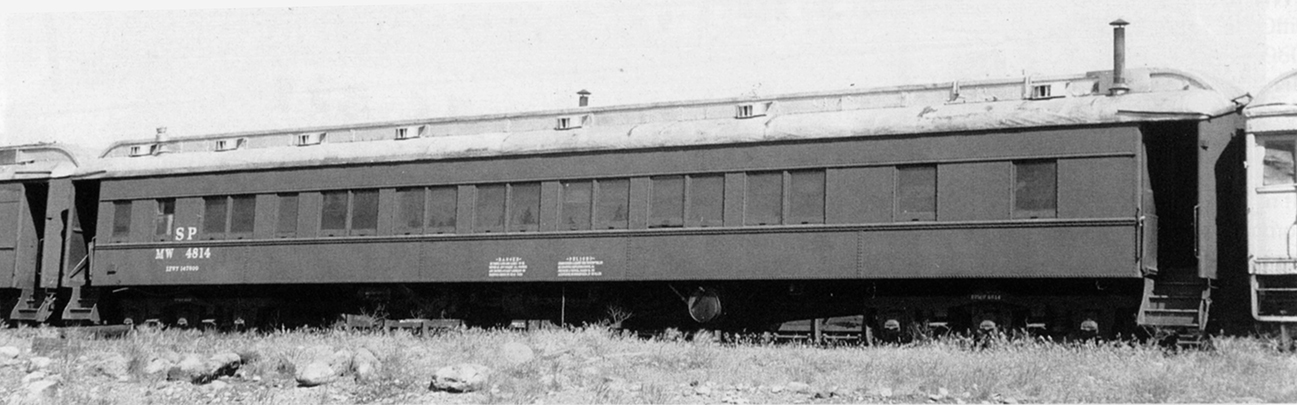
Below is an example, SPMW 4814, an L..L. Bonney photo (Arnold Menke collection) taken at Truckee in July 1963. It’s from the superb book by Ken Harrison (Southern Pacific Maintenance of Way Equipment, SPH&TS, 2022). Ken refers to these Pullmans as the “third generation” of SP equipment like this, as all the ancient passenger cars and modified box cars previously used were wearing out and had to be replaced. That helps explain the SP purchase of 78 cars like this. On this car, the car number is not centered, but on many cars it was located at car center.
As mentioned at the top of this post, a model in the display at Bakersfield inspired me to pursue this project; it was by Todd Osterberg. It’s simply a Rivarossi 12-1 Pullman model, repainted with the body entirely in boxcar red, and the roof aluminum (though rather dirty, as no doubt happened rapidly). Here is Todd’s model. Having lots of window shades pulled down disguises the lack of interior.

My own project began with a Rivarossi (AHM) Pullman from my stash, bought years ago when these were on sale. It happened to be a model decorated for C&O, as you see here.

I removed the roof (which was black), masked the window glazing, and gave it a coat of gray primer. I then did the same to the car body. This avoids having to strip the paint, and adequately conceals the original paint and lettering.

With that paint well dried, I painted the roof with Tamiya “Gloss Aluminum” (TS-17), and the body and trucks with Tamiya “Fine Surface Primer (Oxide Red).” This latter color is a little more red than conventional boxcar red, but SPMW cars often looked a little that way, so in my view it’s a good choice. Note below that I’ve removed the “Talgo” couplers from the trucks. I will body-mount the couplers on this car.

Next comes lettering. As is evident in the Bonney photo at the top of the post, lettering was extremely simple. We SP modelers of the transition era have long used (and often cursed) Microscale set 87-155, as it has little of the correct size or style that we can use for MW cars. But now Owl Mountain Models has several very useful and accurate sets of MW decals (see them at: https://owlmtmodels.square.site/shop/1200-series-ho-decal-sets/5?page=1&limit=60&sort_by=category_order&sort_order=asc ). 

The new Owl Mountain set include very nice, clear versions of the iconic SPMW “Danger” warnings, which were in English and Spanish by the time I model. (For completeness, I will supply the English text of these warnings: “As these cars are liable to be moved at any moment, all parties are warned against lounging or sleeping under or near them.”) You can see these warnings to the right of center on the model below, and in the prototype photo at the top of this post.

One nice modeling challenge that isn’t necessary is diaphragms, as these were removed for MOW service. But still to come, the interior needs to be dealt with, and  I need to weather the car, hopefully as nicely as Jason Hill’s model shown above. Those issues will be presented in a future post.

Tony Thompson

Monday, November 6, 2023

Route cards, Part 28: ice refrigeration

In roughly ten immediately previous posts in this series about route cards (or other cards typically affixed to the route card board on the side of a freight car), I have shown routing cards, directing a car to some destination; grading cards, reflecting an inspection of the car interior for suitability for various kinds of loads; and other cards, directing other car needs, such as cleaning out. But there are still more kinds of cards that might be seen. This post is about cards for ice refrigeration.  

Most of what I show today is again from Michael Litant’s collection. I greatly appreciate his generosity in loaning these to me and giving permission for me to post them in this blog.

I will begin with a real clear legend on a card directing service for a car with a particular need. It’s from the Santa Fe and is 3.5 inches square. No car identification is needed on a card like this.

Another card reflecting icing is this Pacific Fruit Express card identifying that the car is set up for half-stage icing. It is 4 x 6 inches in size. Essentially the same card, provided by Ralph Heiss, was shown in an earlier post on this topic (located here: http://modelingthesp.blogspot.com/2016/07/route-cards-part-12-more-examples.html ). Like the card above, it is likely that this card would have been placed on what was called the “commodity card board,” not on the route card board.

Some readers no doubt are mumbling to themselves, “what the heck is a commodity card board?” These are visible on steel reefers after about 1950, as I show for PFE Class R-40-26 below (PFE photo, courtesy CSRM ). The large, upper board to the left of the door is the placard board, the smaller one below it is the commodity card board. (These boards have sometimes been called “auxiliary placard boards.”) The route card board is just visible on the left bolster, below and to the left of the fan plate. You can click on the image to enlarge it.

I’ve described modeling these boards in an earlier blog post (you can see it at: http://modelingthesp.blogspot.com/2013/09/a-classic-ho-scale-car-kit-one-more-time.html ).

For another example of a card that might well be located on the commodity card board, below is another stage icing card, this one not identified as to issuing railroad or car owner. It is only 1 x 4 inches.

I should perhaps mention what “stage icing” or “half-stage icing” was. The ice grates at the bottom of the ice bunker supported the ice while allowing meltwater to drain. In a car equipped for half-stage icing, the grates could be moved upwards to rest on a support on the wall between the bunker and the car interior. Then the standard icing process, filling the bunker to the top, used less ice.

For more on stage icing, use of salt, and other operational matters, see the PFE book (Pacific Fruit Express, 2nd edition, Signature Press, 2000), particularly Chapters 8, 14 and 15.

Another consequence of conventional ice refrigeration was that in cold weather, heating was needed instead of cooling. This was accomplished by placing heaters in the ice bunkers, originally charcoal burning, later kerosene or propane. But combustion in a sealed enclosure like a reefer meant that carbon monoxide would be generated. Thus placards like this were placed on placard boards, and sometimes also on ice hatch covers. It’s 7 x 9 inches in size.

Finally, an interesting card directing the addition of salt to a reefer (REX 7499, a 54-foot express reefer); it calls for 3% salt. This is a Railway Express Agency card, interesting in itself. It is 4 x 6 inches, and was issued at Yakima, Washington on June 17, 1966. The cargo is identified as cherries, consistent with that date. I like the seemingly redundant instruction, “If no salt is to be used, do not attach salt card.”

All these cards reflect what was called “protective services” in the tariff books, both icing arrangements and additions of salt. Since I’m something of a reefer enthusiast myself, these are especially interesting to me, and I am contemplating how and when to model some of these for operations on my layout.

Tony Thompson

Friday, November 3, 2023

The new SP Berkshire locomotive models

As I’m sure was the case for many Southern Pacific modelers, the recent announcement by Broadway Limited Imports (BLI) of new HO scale locomotive models of the Boston & Maine Berkshires was of interest. These engines ran for almost 20 years on the B&M, their original purchaser, but in the summer of 1945, both SP and Santa Fe each bought ten of these locomotives from the B&M.  

Why did the two roads make these purchases? The War Department had warned both railroads that with the concluding of the war in Europe, there would be heavy traffic across the U.S., transferring men, supplies and equipment from the European Theater to the Pacific, in preparation for what was expected to be a major campaign invading the home islands of Japan. Thus both railroads went out to acquire additional locomotives. That the atomic bomb would end World War II was, of course, not yet known.

The BLI announcement includes locomotives decorated for both SP and Santa Fe, two engine numbers for each railroad. Below I show the BLI artwork for the SP models. They included the smaller “Southern Pacific Lines” lettering on one engine because when the engines arrived on SP rails in August 1945, that was the official paint scheme. SP changed to the larger lettering and eliminated “Lines” in June 1946. 

Both tenders shown by BLI are the original B&M coal tenders, and indeed the SP locomotives were initially operated with those tenders, exclusively on the Rio Grande Division, SP’s only coal-fired division at that time. But in subsequent years, all ten engines were converted to oil fuel and migrated to California in the spring and summer of 1950. So my first thought was, could I use one of these distinctive locomotives on my layout?

Below I will describe some of the research I did to answer that question. In doing so, I don’t intend to praise or criticize the models themselves, and my goal is only to show the kind(s) of research that is possible with the sources we have. I certainly don’t wish to suggest what anyone else’s purchasing decision should be.

First, it’s worth remembering that these B&M Berkshires were part of the “Superpower” revolution at Lima Locomotive, brainchild of designer Will Woodard, and were capable of impressive horsepower in freight service. Built in 1928, perhaps the main criticism of them would be their retention of Lima’s articulated trailing truck design, something that found favor with few buyers of Lima power.

Second, let’s look at one of these Berkshires soon after SP arrival. (Allan Youell photo at El Paso, 1947, courtesy Guy Dunscomb). Here the very distinctive Coffin feedwater heater on the boiler front stands out (standard SP practice was to paint the entire boiler front aluminum, which is obvious here). The locomotive also still has its B&M trailing truck booster, alligator crosshead, and Baker valve gear. SP had applied train indicators, which BLI has included on the SP models, and blowdown spreaders, which I don’t see in the BLI artwork.

All ten engines remained pretty much like this on the Rio Grande Division from their arrival in August 1945 until the fall of 1949, when they began to be converted to oil fuel and of course given oil tenders. Exact dates and locations of these changes can be found in the Steam Locomotive Compendium (Timothy Diebert and Joe Strapac, Shade Tree Books, 1987).

So the first conclusion about using one of the BLI models is that until the fall of 1949, they ran only on the Rio Grande Division on account of being coal fired. It wasn’t merely unlikely that they would be seen elsewhere on the SP in that period, it was effectively impossible.

So how did these engines look when they had oil tenders? Below I show SP 3500, in a G.M. Best photo at Los Angeles in late 1949. The engine had its oil conversion at El Paso in September, and here it is in California, looking freshly painted. SP preferred multiple-bearing crossheads and Walschaerts valve gear, and any engine not already so equipped was modified. Those two big cylindrical things on the pilot beam are shields over the air pumps. And notice the dry pipe along the top of the boiler, from the superheater in the smokebox to the turret. Booster has been removed.

The tender tank, the upper part of the tender body, is from a retired 4000-series articulated, but it was placed on the original B&M tender frame, and the B&M trucks retained. The reason was to preserve the original arrangement of the drawbar between the engine’s articulated trailing truck, and the tender. For more on this, see Southern Pacific Steam Pictorial, Volume II (Guy L. Dunscomb, Donald K. Dunscomb, and Robert A. Pecotich, Dunscomb Publishing, 1999).

At this point, a second conclusion about the BLI models is that if you want to operate them on a California layout, they need to have oil tenders. It would be an interesting and not impossibly difficult project to built a semi-cylindrical or “whaleback” tender body and put it on the frame and trucks of the BLI models. But this would be getting far beyond an out-of-the-box model, and replacing crossheads and valve gear for the low-numbered engines offered by BLI, even more so.

Apparently records aren’t clear about which engines lost their boosters and when, but at least three did (boosters were out of favor at SP by this time, and many SP locomotives that had been built with boosters lost them in late steam days). Eventually all the engines also lost the prominent Coffin feedwater heaters, which very dramatically changed their appearance (Santa Fe also replaced those heaters.) Below is shown SP 3504, photographed by Guy Dunscomb at Modesto, California in April 1950.

Where did these engines operate after they came to California in 1950? I happen to have an SP Locomotives Assigned pamphlet for March 31, 1950. At that time, all ten of the Berkshires remained in service, but only two were still on Rio Grande Division, SP 3506 and 3509. All the others had been assigned to the San Joaquin Division.

So a third point to be made is that the Berkshires were assigned to Jan Joaquin Division, and we know they remained there until they began to be scrapped. The strict meaning of this is that you would only want one of these engines if you model San Joaquin Division, but in fact engines did sometimes run through on other divisions, or have break-in runs after shopping on other than their home division, so one could stretch the geographic restriction to some extent. Since I model Coast Division, some rationale like that would have to be applied.

Lastly, as batch after batch of EMD F units continued to arrive on SP in 1950 and beyond, more and more steam freight power became surplus, especially “oddballs” like the Berkshires. All the Berkshires were vacated from the roster between the late fall of 1950 and mid-summer 1951 (individual dates are in Diebert & Strapac).

Thus my fourth and final point is that these distinctive locomotives were gone from the SP by August 1951. I model 1953, so it would require more than a small time warp for me to operate a BLI Berkshire. I’m still kind of tempted, but I would certainly have to face up to removing the Coffin feedwater heater and buying or building a tender, not trivial projects. 

But as I already remarked, I am not trying to tell anyone else what to think about these models. Particularly those with the “collector” itch  (something I suffer from myself) may find these hard to resist. 

Tony Thompson

Tuesday, October 31, 2023

The 2023 SPH&TS annual meeting

This year’s annual meeting of the Southern Pacific Historical & Technical Society was held last weekend in Bakersfield. It was an enjoyable meeting, buoyed by the attendance of 140, a considerable advance over last year’s meeting in Modesto which only drew 75. Many organizations around the country are reporting slow attendance recoveries like this from the pandemic years, so I guess we are in that pattern too.

A notable feature was the large and quite busy vendor and sales room. Some sellers we haven’t seen for awhile were there, and we saw some intriguing new products (the most notable ones will be the subject of a separate post or posts). Here’s a view of the room:

Clinics were presented in a quality program, an aspect I always enjoy, because I learn a lot every time. A notable speaker was Jean-Guy Dubé, the arctitectural draftsman who has been measuring and recording a number of SP depots in blueprint form. He used as his introductory slide, the cover of his beautiful book which collects some of those drawings.

I should mention that I also gave a talk, combining my Model Railroad Hobbyist articles from January and October of this year, to speak about SP heavyweight and lightweight sleeping cars. There’s a handout for the talk here: https://modelingthesp.blogspot.com/2023/10/handout-for-passenger-car-talk.html .

The model display was also excellent this time. I really liked a number of the entries. The one I think I like best was this re-creation of the Arrowhead Water tank car, often called “the water bottles,” for obvious reasons. It was 3-D printed by A.J. Chier. This model is just like the prototype photos.

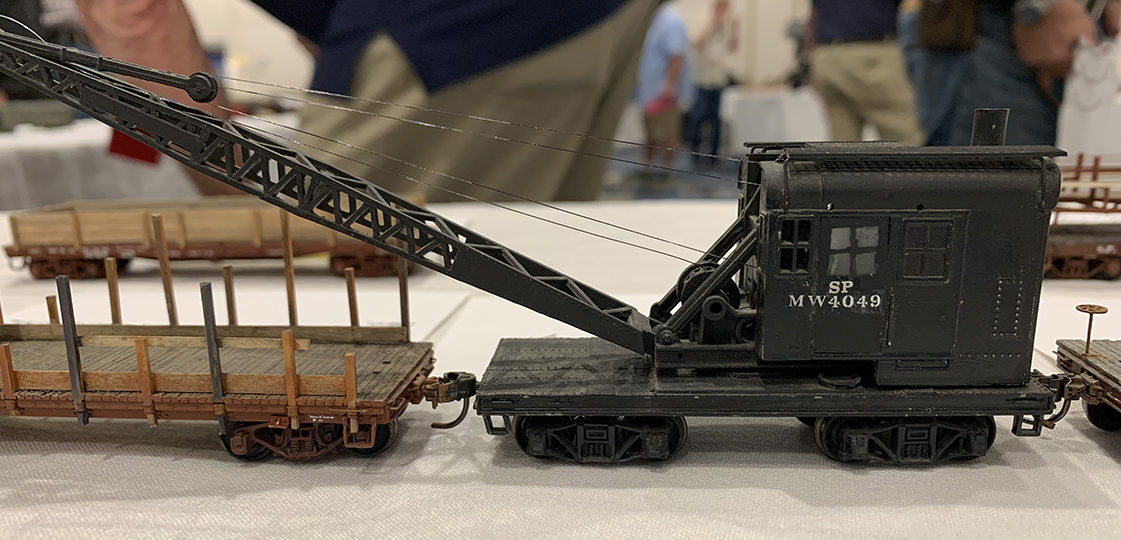
Another entry that got me thinking was this nice modification of the Walthers 25-ton crane, a type the SP owned in some numbers. In fact, this model suddenly made me think, “Haven’t I got a kit for this model in my storage somewhere? I could do one of these too!” Can’t beat that for inspiration. (Sorry my photo cuts off the end of the boom.) I found out later the model is by Jason Hill.

Another interesting model entry was among those placed in the Saturday-morning only “Railroad Prototype Modelers” meet, open to the local modeling community, SP or otherwise, without convention registration. I think this broadening of the meeting with an RPM event was a great idea, if for no other reason that it provide more nice models to look at! 

 That specially interesting entry was from Charlie Slater, who brought this Santa Fe Class Ft-X flat car. Both the  ready-to-run car and the transformer load are from Class One Model Works, except Charlie removed some boards from the end deck, as he has seen shippers do, so that hold-downs could be welded right to the car frame. The boards were then left loose on the car, and could be re-bolted in place at a later date. You can click to enlarge.

All in all, a nice variety of events in the meeting (marred only by a substandard banquet speaker), lots of camaraderie with the good attendance, and even nice weather, something for which Bakersfield is not normally known. I liked it. If you’ve never attended a meet like this, I encourage you to try one. You would probably like it too.

Tony Thompson

Saturday, October 28, 2023

Handout for passenger car talk

 This post is a handout for a talk about Southern Pacific passenger car modeling. The talk concentrates on sleeping cars, both heavyweight and lightweight. Much of the modeling described in the talk is included in articles I wrote for Model Railroad Hobbyist (the January and October 2023 issues).  

My core idea, for this part of the SP passenger car equipment fleet, is using the sleeping car models produced by Rivarossi in Italy, and marketed in the U.S. by AHM (Associated Hobby Manufacturers). A very useful one is the “1920 Pullman” car, as AHM sold it, since it models the most common single floor plan in the original Pullman fleet: a “12-1,” as they were called, 12 sections and 1 drawing room. 

Also produced was an AHM “1930 sleeper” model, which is essentially a 10-6 (10 roomettes, 6 double bedrooms), probably the most common lightweight sleeping car floor plan. It can be repainted for Lark service, as I have done, and given upgraded details. Below you see one of these cars, with an AHM heavyweight Pullman conversion right ahead of it, passing the depot in my layout town of Shumala.

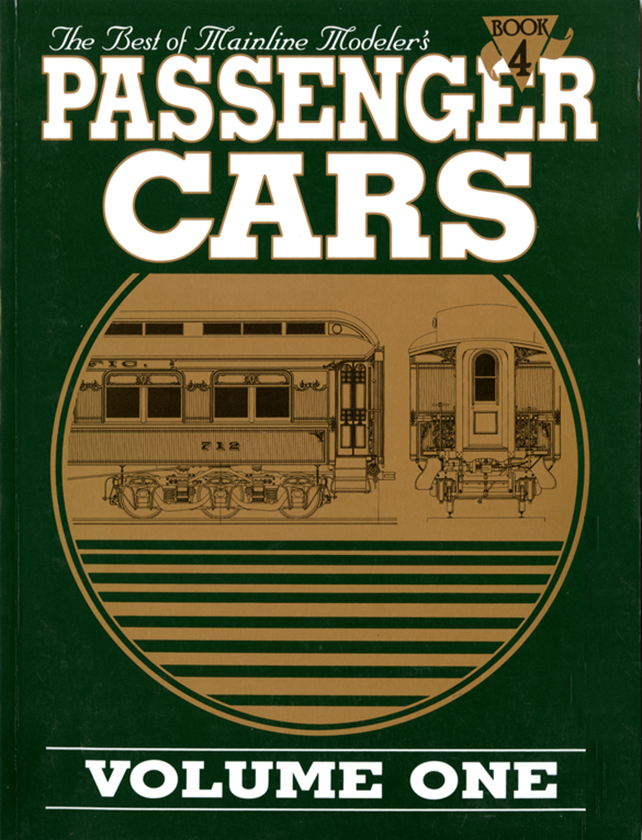
The AHM “1920” heavyweight Pullman can readily be kitbashed into a number of other floor plans, as shown in a superb series of articles in Mainline Modeler, in five issues during 1981. Magazine issues can be hard to find, on-line or elsewhere, but a perhaps easier source for these articles are the verbatim reprints of all five articles, contained in the Mainline Modeler reprint book shown below.

An essential source of information and photographs, for the Southern Pacific modeler, is the five-volume series of books entitled Southern Pacific Passenger Cars and published by the SP Historical & Technical Society. For the present topic, Volume 2 on sleeping cars was vital.

In addition to the many important pieces of information about individual cars in the book shown above, there is another SPH&TS book of great importance also, the painting and lettering guide. Both can be purchased on-line and the latter from the Society at its website.

Here are references for the five most important books mentioned in the talk: 

___________, The Best of Mainline Modeler’s Passenger Cars, Volume 1, Hundman Publications, Seattle 1991.

Cauthen, Jeffrey Alan, and John R. Signor, Southern Pacific Painting and Lettering Guide (“Locomotives and passenger cars, 1913–1996”), SPH&TS, Upland, CA, 2019.

 Ryan, Dennis and Joseph Shine, Night Trains of the Coast Route, Four Ways West, La Mirada, CA, 1986.

SPH&TS, Southern Pacific Passenger Cars, Volume 2, Sleepers & Baggage-Dormitories, SPH&TS, Pasadena, 2005.

Wayner, Robert, Pullman Company Descriptive List of Cars, 1950, Wayner Publications, New York, NY, 1985.

In the talk, and in the MRH articles mentioned in the first paragraph, I showed a variety of sleeping cars that I was able to build from the AHM sleeping car models. The MRH articles contain extensive bibliographies. Much if not all of the material was previously shown in my blog; links are below.

First, some links to basic passenger car modeling, the concluding posts in each series:

https://modelingthesp.blogspot.com/2014/09/modeling-sp-passenger-cars-sleepers.html

https://modelingthesp.blogspot.com/2014/07/modeling-sp-passenger-cars-heavyweight.html

https://modelingthesp.blogspot.com/2018/02/my-pullman-projects.html

https://modelingthesp.blogspot.com/2018/05/the-problems-of-dark-olive-green.html

https://modelingthesp.blogspot.com/2022/11/heavyweight-sleepers-conclusion.html

https://modelingthesp.blogspot.com/2023/10/modeling-sp-passenger-cars-part-18.html

I have also written extensively about passenger car diaphragms, full width and otherwise:

https://modelingthesp.blogspot.com/2014/06/modeling-sp-passenger-cars-part-5.html

https://modelingthesp.blogspot.com/2021/05/passenger-car-diaphragms-part-2.html

https://modelingthesp.blogspot.com/2021/08/full-width-diaphragms-part-2.html

https://modelingthesp.blogspot.com/2021/08/full-width-diaphragms-part-3.html

https://modelingthesp.blogspot.com/2021/07/passenger-car-diaphragms-part-4.html

Among the other blog posts that may be informative, here are two about the Lark:

https://modelingthesp.blogspot.com/2021/07/modeling-sp-passenger-cars-part-11-lark.html

https://modelingthesp.blogspot.com/2021/07/the-challenge-of-full-width-diaphragms.html 

With these links, it should be possible to see the background modeling in more detail than was possible to present in a single talk, or for that matter, in the two MRH articles. In addition, most of the above posts that are linked contain significant prototype information too.

Tony Thompson

Wednesday, October 25, 2023

My latest column in _Model Railroad Hobbyist_

In the October issue of the “Running Extra” section of Model Railroad Hobbyist (MRH), I have another column in the continuing series of “Getting Real” columns, written (currently) by four people including me, in rotation. You can find the article on their website, www.mrhmag.com , though if you’re not a subscriber to “Running Extra,” you will need to pay $2.99 for it. (Price per issue is cheaper if you subscribe.)

This latest column is about modeling Southern Pacific lightweight sleeping cars, something I have been describing in this blog in recent months, and it complements my column about modeling heavyweight SP sleeping cars, which was in the January 2023 issue of MRH. The two articles have a few details in common, but largely are the two ends of the same story.

My focus has been on sleeping cars because I have always admired the Lark. It was still steam-powered in my modeling year, 1953, and if I had the layout capability, I would be creating full Lark consists to operate. Maybe I can convey that with the Bill Olson photo shown below, taken in the summer of 1952, at Glendale, the Lark’s last stop before arrival at Los Angeles.

The core of the MRH article, and of the series of blog posts, was the use of Brass Car Sides products to model a couple of cars with less-common floor plans. Shown below is one of the sides, in the process of being glued (with canopy glue) to an AHM coach body from which all areas that showed behind the Brass Car Side had been cut away. Reversed clothes pins are being used as parallel clamps. (See: https://modelingthesp.blogspot.com/2023/04/modeling-sp-passenger-cars-part-13.html .)

But of course the goal is to produce finished cars that can be operated on the layout. Painting and lettering was naturally a vital part of that; see my post about decals, at: https://modelingthesp.blogspot.com/2023/10/modeling-sp-passenger-cars-part-18.html , and preceding posts in this series. Here’s an example of a result, the bedroom side of the 13 double bedroom car, with its distinctive paired windows. The roof is in place, as are the handrails.

As I’ve mentioned in previous posts, I have done this kind of striping for years by masking and airbrushing. Decal stripes on a long car are just not a fun project, as I learned the hard way. Below is a close-up illustration of what can be accomplished, on a car with a full-width diaphragm.

And when the cars are completed, I usually operate them, one or two at a time, in short passenger extra trains, representing deadhead moves, or sometimes in excursion trains. (I described my efforts to operate passenger equipment realistically on my fairly small layout in a post a couple of years ago: https://modelingthesp.blogspot.com/2021/05/mainline-passenger-cars-on-small-layout.html .)

In the photo above, you see my completed 4-4-2 (4 compartments, 4 double bedrooms, 2 drawing rooms) sleeping car, one of the two cars I constructed using Brass Car Sides, bringing up the rear of a deadhead move. Ahead of the Lark sleeper is a heavyweight Pullman sleeper, an RPO car, and a baggage car. The train is just passing my layout town of Shumala, located on SP’s Coast Division main line.

One part of this latest column that may be of particular value (if you're interested in SP sleeping cars) is that I provided a long series of links at the end of the article, for the relevant blog posts I’ve created over a span of years. Much of that is included in my handout for my talk about this topic, which is at this link: https://modelingthesp.blogspot.com/2023/01/handout-for-sp-passenger-equipment-talk.html .

It was interesting to extract the essence of a number of previous blog posts, and a number of additional model and prototype photos, and create a completed article for MRH. It captures, I think, my approach to representing at least some of the allure of the Lark.

Tony Thompson

Sunday, October 22, 2023

Route cards, Part 27: back to grading cards

 In an evear-growing series of posts, I have been writing about both route cards, cards that direct movement of freight cars, and grading cards, those that give results of an inspection of a car interior for loading. This one continues my topic of grading cards and systems. The previous post on this part of the subject can be found here: https://modelingthesp.blogspot.com/2023/09/route-cards-part-25-still-more-grading.html . As before, all cards are from the collection of Michael Litant.

The first example I want to show is from the Chicago & Eastern Illinois, identifying a car that is suitable for grain loading. It’s 3 x 4.25 inches in size. Note that the form would permit an inspector to choose a class of loading (for example, A, B, C, etc.) but here the choice was a specific cargo, perhaps because lots of grain was being loaded. The car number, 64127, is clear, but the only initial shown is “C,” probably the usual practice of abbreviating the home road’s cars. If so, it was a 40-foot boxcar of 1937 AAR design.

A second example is another of those interesting multi-sided cards, this one hexagonal, from the Burlington. It’s 6 inches across the parallel sides. It’s dated June 18, 1968 at Cicero, Illinois, and the car given a grade 1 rating was Q 48056, a 50-foot, double-door box car of 70-ton capacity. Note that the second side has a lot of non-grading segments, such as clean out, quick clean, bad order, light weigh, and so on.

The next example is a really interesting pair of cards for the same railroad, Northern Pacific, but they are quite different from each other. The first one is a fairly typical type of card, 5 inches square, with the usual range of grades. The side used was the second side, and the grade of CC chosen for car 48056. It was graded at Auburn, Washington on November 1, 1968. Since the preceding card was for the same car, a 50-foot box car, and the date is later, obviously collector Michael found these two cards with one atop the other. 


The other NP car is of the “extreme cargo detail” variety, and is evidently meant to be folded to make the operative side uppermost. It’s 5 x 10 inches overall, but folded it would be 5 inches square. It appears to be dated May 27, 1965 at Seattle, and the car was NP 97034, a 50-foot RBL (bunkerless) refrigerator car.


My fifth example is from the M-K-T, usually called the “Katy,” and is interesting because it seems to contemplate only one typical cargo for each grade, A and B. It’s 4 x 4 inches, and isn’t filled out.

As a final example, here is a card from a much smaller railroad, the Savannah & Atlanta, and is 4.5 x 5 inches in size. It isn’t filled out. The back just shows “P.W.-10,” the meaning of which I can’t supply.

This marvelous collection of route and grading cards, loaned to me by Michael Litant for scanning, is really a trove of information for me. I hope others have also found these cards informative as well as interesting.

Tony Thompson